

 From Procedural Choice to Legal Strategy
For many years, the question of whether to choose court litigation or arbitration was often treated as a purely procedural decision. However, by 2026, in the context of Vietnam’s deep institutional reforms and increasing integration into the global financial system, this choice has evolved into a strategic legal decision with long-term implications.
The parallel operation of litigation under the Civil Procedure Code 2015 and dispute resolution under the Law on Commercial Arbitration 2010 no longer represents two alternative mechanisms. Instead, they are increasingly forming a multi-layered dispute resolution ecosystem, in which each mechanism plays a distinct and complementary role.
More notably, with the implementation of the legal framework for the International Financial Centre (IFC) starting in 2026, Vietnam’s system is undergoing a process of “internationalization,” aligning more closely with global standards seen in jurisdictions such as Singapore and the United Kingdom.
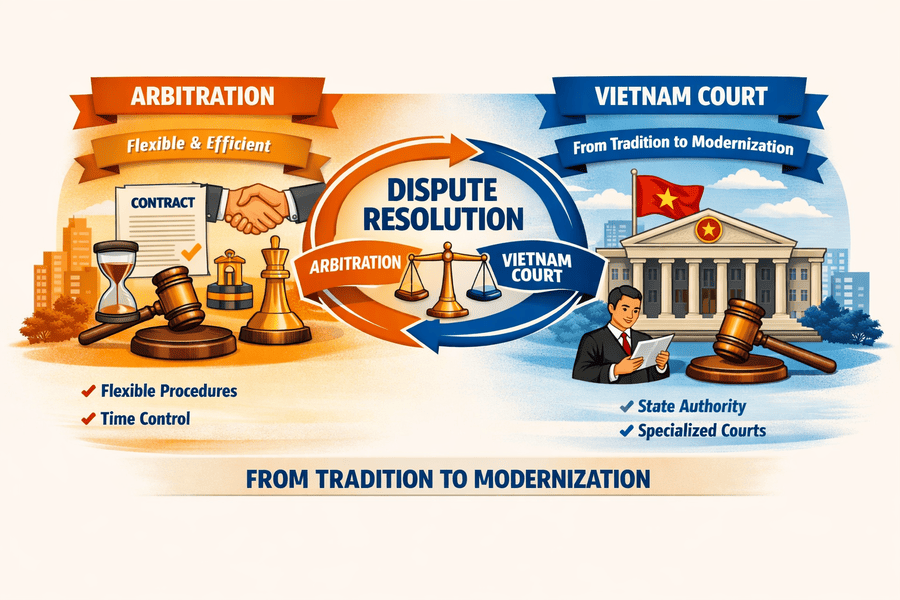
Vietnamese Courts: From Traditional Mechanism to Institutional Repositioning
Courts have long been regarded as the cornerstone of the judicial system, with their fundamental strength lying in state authority and enforceability. However, from a practical perspective in commercial dispute resolution, the very procedural rigor designed to ensure fairness has often resulted in prolonged timelines and reduced flexibility.
Under the framework of the Civil Procedure Code 2015, a typical civil case may proceed beyond first-instance adjudication to appellate review, and in some cases, to cassation or reopening procedures. This multi-tiered structure provides robust legal oversight, yet simultaneously creates a paradox: high legal certainty but lower economic efficiency.
Recognizing these limitations, judicial reforms during 2025–2026 have begun to reshape the role of the courts. The establishment of specialized courts within the International Financial Centre framework is not merely intended to shorten dispute resolution timelines, but also to introduce a more flexible adjudicative approach—one that enables judges to engage with international practices, particularly in financial and investment disputes.
From this perspective, Vietnamese courts are no longer merely adjudicative bodies; they are gradually emerging as competitive institutions within the global dispute resolution landscape.
Commercial Arbitration: Flexibility and Institutional Maturity
If courts represent procedural formality, commercial arbitration reflects the dynamics of the market—flexible, efficient, and grounded in party autonomy.
Governed by the Law on Commercial Arbitration 2010, arbitration allows parties to retain significant control over the dispute resolution process—from selecting arbitrators and determining procedural rules to managing timelines. This is particularly valuable in disputes involving technical complexity or cross-border elements, where expertise and efficiency are critical.
However, the true value of arbitration in Vietnam has only become evident in recent years. Judicial practice indicates that Vietnamese courts are increasingly reluctant to interfere with arbitral awards. The relatively low rate of annulment is not merely statistical; it reflects a fundamental shift in judicial mindset—from control to deference.
This evolution has positioned arbitration not as a supplementary mechanism, but as a primary dispute resolution method in international commercial transactions involving Vietnam.
The Real Difference: Not Procedure, but Institutional Philosophy
Comparisons between courts and arbitration often begin with familiar factors such as time, cost, and confidentiality. Yet, at a deeper level, the fundamental distinction lies not in procedural mechanics, but in their underlying institutional philosophy.
Courts are built upon public authority, where legal rules are applied in a uniform and mandatory manner. Arbitration, by contrast, is rooted in contractual freedom, allowing parties to effectively “design” their own dispute resolution framework.
This divergence leads to important consequences. While courts provide legal certainty and strong enforcement power, arbitration offers an environment more aligned with the realities of international commerce—where speed, confidentiality, and flexibility are often paramount.

Trends in 2026: Toward a “Hybrid Justice” Model
One of the most notable developments in Vietnam in 2026 is the emergence of a “hybrid justice” model—a convergence between courts and arbitration.
In this model, the boundary between the two mechanisms is increasingly blurred. Courts are no longer positioned in opposition to arbitration; instead, they act as supporting institutions, assisting with interim measures and the recognition and enforcement of arbitral awards. At the same time, arbitral institutions are incorporating elements of mediation and addressing complex, multi-contract disputes, reflecting the growing sophistication of commercial transactions.
In particular, the rise of serial disputes—where multiple contracts and parties are interconnected—has introduced new challenges. In such contexts, relying on a single dispute resolution mechanism is often insufficient. What is required instead is a comprehensive dispute resolution strategy, integrating multiple legal tools.
Strategic Perspective: A Necessary Shift for Businesses
Perhaps the most significant change in 2026 lies not in the law itself, but in how businesses approach disputes.
Where disputes were once addressed reactively, they must now be managed proactively—beginning at the contract negotiation stage. Dispute resolution clauses are no longer boilerplate provisions; they are integral components of a broader legal strategy, closely linked to investment structures, financial flows, and long-term business objectives.
Accordingly, the choice between arbitration and court litigation should not be made on intuition. It requires a careful assessment of multiple factors, including enforceability, the international nature of the transaction, the complexity of potential disputes, and even the company’s broader negotiation strategy.
A Maturing Dispute Resolution Ecosystem
By 2026, Vietnam’s dispute resolution framework can no longer be characterized as merely “developing.” It is entering a phase of maturity, marked by clear structural advancements.
Courts are evolving toward specialization and internationalization. Arbitration is consolidating its position as a reliable and effective mechanism. More importantly, the interaction between these two systems is creating a flexible ecosystem, enabling businesses to select—or strategically combine—legal tools in an optimal manner.
In this context, competitive advantage no longer lies in the ability to “resolve disputes effectively,” but in the capacity to design strategies that anticipate and control disputes from the outset.
Read more other relevant articles:
- Dispute Resolution through Arbitration and Court
- Can an arbitral award be set aside in Vietnam for ignoring key evidence?
- Mechanisms for Resolving Commercial Disputes Outside of Courts