
Vietnam’s Law on Investment 2025 (No. 143/2025/QH15), effective from 1 March 2026, with the new conditional business lines list applying from 1 July 2026, has reduced the number of conditional sectors from 237 to approximately 198. This reform removes 38 lines and narrows another 20, significantly easing market entry for many FDI projects.
However, many high-value and regulated sectors important to foreign investors remain conditional. These still require additional licenses, permits, capital requirements, professional qualifications, or ownership restrictions beyond the standard Enterprise Registration Certificate (ERC) and Investment Registration Certificate (IRC).
This article provides a practical, up-to-date ranking of the Top 10 conditional sectors that most FDI clients need to prepare for carefully in the second half of 2026 and beyond.
Why Conditional Sectors Still Matter in 2026
Even with reforms, operating in a conditional sector means you must satisfy specific statutory conditions related to national security, public order, social ethics, or public health. Failure to obtain the extra licenses can result in delayed operations, fines, or project suspension.
Key changes post-July 2026:
- Shift toward post-inspection (hậu kiểm) in some areas.
- Clearer distinction between pre-approval licenses and public disclosure of conditions.
- Many former conditional services (e.g., certain customs brokerage, tax agency, and basic inspection services) are now freer.
Top 10 Conditional Sectors Still Requiring Extra Licenses (2026)
Here are the most relevant sectors for foreign investors, ranked by practical impact on FDI:
1. Banking, Finance & Insurance
Foreign ownership caps typically apply (e.g., 30% aggregate for commercial banks, higher with Prime Ministerial approval). Requires licenses from the State Bank of Vietnam or Ministry of Finance. Additional capital, governance, and risk management requirements remain strict. Casino, betting, and credit rating services are also heavily regulated.
2. Real Estate Development & Trading
Foreign investors can own 100% in many projects but must obtain construction permits, land use rights, and specific real estate brokerage licenses. Large-scale projects or those involving housing for sale/lease still face tight conditions on capital, project approval, and foreign ownership ratios in certain residential segments.
3. Education & Training (Including Foreign-Owned Schools)
All levels — from kindergartens to universities and vocational training — require education licenses from the Ministry of Education and Training. Foreign-invested educational institutions face specific conditions on facilities, curriculum approval, foreign teacher qualifications, and investment capital minimums.
4. Healthcare, Medical Services & Pharmaceuticals
Hospitals, clinics, and pharmaceutical manufacturing/distribution need Ministry of Health licenses. Foreign ownership is allowed but subject to conditions on equipment standards, professional staff qualifications, and technology transfer. Drug import and distribution remain tightly controlled.
5. Logistics & Transportation (Road, Sea, Air, Rail)
While many sub-sectors have been liberalized, key activities like international maritime transport, air transport (foreign ownership cap ~34-49%), port operations, and dangerous goods transport still require specialized licenses from the Ministry of Transport. Warehousing and freight forwarding may need additional approvals.
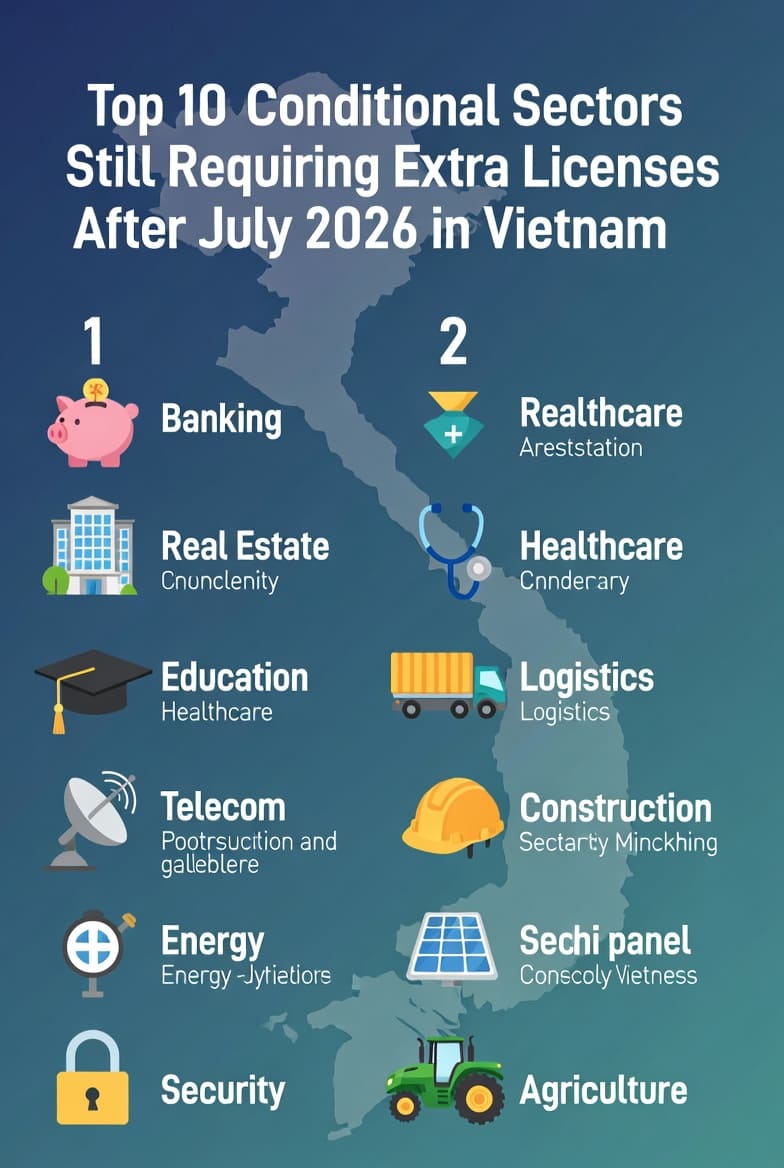
6. Telecommunications, Internet & Broadcasting Services
Foreign ownership capped at 49% for many infrastructure-related services. Requires licenses from the Ministry of Information and Communications for network operation, value-added services, data centers, and content broadcasting. Social media platforms and e-commerce intermediaries face new conditional rules in 2026.
7. Construction & Related Engineering Services
Surveying, design, supervision, project management, and inspection services require practicing certificates and licenses from the Ministry of Construction. Foreign contractors must meet experience, financial, and personnel conditions.
8. Energy & Mining (Including Oil & Gas, Electricity)
Power generation, transmission, renewable energy projects, and mineral extraction require specific investment approvals, environmental impact assessments, and operation licenses from the Ministry of Industry and Trade or Electricity Regulatory Authority. Large projects often need high-level government approval.
9. Security & Defense-Related Services
Production and trading of supporting tools, military equipment, security services, and certain high-risk chemicals remain strictly conditional with licenses from the Ministry of Public Security or National Defense.
10. Agriculture, Forestry, Fisheries & Food Processing
Breeding endangered species, exporting rice, trading in plant protection chemicals, veterinary drugs, and large-scale farming often require specialized permits from the Ministry of Agriculture and Rural Development. Food safety and quarantine conditions are rigorous.
Practical Tips for FDI Investors in Conditional Sectors (2026)
- Early screening is critical — Check both the general conditional list (Appendix IV) and sector-specific decrees.
- Leverage the new ERC-first route — Incorporate the company first, then apply for the sector license to save time.
- Minimum capital & experience — Many sectors still impose higher charter capital and proven track record requirements for foreign investors.
- Joint venture considerations — In restricted ownership cases, choose reliable Vietnamese partners carefully.
- Timeline impact — Expect 2–6 additional months for licenses in complex sectors like banking, education, or healthcare.
- Post-July 2026 compliance — Even in liberalized sectors, maintain strong internal controls as authorities shift to post-audit enforcement.
How Our Firm Helps Foreign Investors Navigate Conditional Sectors
With deep expertise in Vietnam’s evolving FDI framework, we assist clients with:
- Precise business line classification under the 2026 list.
- Preparation and submission of sector-specific license applications.
- Structuring ownership and capital to meet market access conditions.
- Full compliance roadmaps tailored to your industry.
Ready to invest in Vietnam in 2026?
The reduction in conditional sectors creates major opportunities — but success in the remaining regulated areas requires precise legal navigation.
The information provided in this article is for general informational and reference purposes only. It reflects the legal framework as of 2026 and does not constitute official legal advice, professional legal opinion, or a substitute for individualized legal counsel. Laws and regulations in Vietnam are subject to frequent changes, and the application of these rules may vary depending on the specific circumstances of each investment project.
We strongly recommend that you consult our experienced FDI lawyers or qualified legal advisors for a detailed assessment, risk analysis, and tailored solutions that best suit your business objectives and specific situation.
This is the second article in our 2026 FDI Series for Foreign Investors in Vietnam.
Read more other related articles:
- FDI Enterprises and the Private Sector Question: An Emerging Interpretative Risk in Vietnam’s Tax Incentive Framework
- FDI Investment Structures in Vietnam under the 2025 Investment Law: IRC, ERC and M&A Approval in a Post-Licensing Regulatory Framework
- Tax Obligations and Incentives for FDI Companies in Vietnam
- Establishing a Legal Entity: Options and Requirements for FDI in Vietnam