

For foreign-invested enterprises (FDI) operating in Vietnam, legal compliance is often associated with investment licensing, tax, labor, accounting, customs, or sector-specific permits. However, one statutory obligation that is frequently underestimated is the periodic investment reporting obligation.
In practice, many investors only realize that their investment reports have not been properly submitted when they intend to amend their Investment Registration Certificate (IRC), transfer an investment project, terminate the project, or undergo an inspection by the investment authorities. At that stage, missing or incomplete reports may result in administrative penalties, requests for additional explanations, or delays in processing subsequent investment procedures.

With the introduction of the Law on Investment 2025 and Decree No. 96/2026/ND-CP, Vietnam has strengthened the digital management of investment projects through the National Investment Information System. Consequently, investment reporting has become much more than a procedural formality—it is now an essential component of an enterprise’s overall compliance framework.
I. Investment Reporting Is Not Merely an Administrative Formality
Many investors still consider investment reporting as a statistical exercise with limited legal significance. In reality, these reports serve as one of the primary tools through which investment authorities monitor the implementation and performance of investment projects throughout their lifecycle.
Through periodic reports, authorities assess various aspects of project implementation, including capital contribution, investment disbursement, project progress, business performance, import and export activities, employment, land use, and compliance with financial obligations.
In essence, investment reports function as the official compliance record of an investment project. They provide the competent authorities with a comprehensive picture of whether the project is being implemented in accordance with the approved investment schedule and applicable laws.
Failure to maintain accurate and timely reports may therefore affect future investment procedures, particularly where authorities need to evaluate the implementation status of a project.
II. Which Enterprises Are Required to Submit Investment Reports?
Pursuant to Article 47 of the Law on Investment 2025, investors and economic organizations implementing investment projects are required to comply with the statutory investment reporting regime.
Accordingly, the reporting obligation is not limited to foreign-invested enterprises holding an Investment Registration Certificate (IRC). Rather, it applies to organizations and investors implementing investment projects that fall within the scope of the Law on Investment.
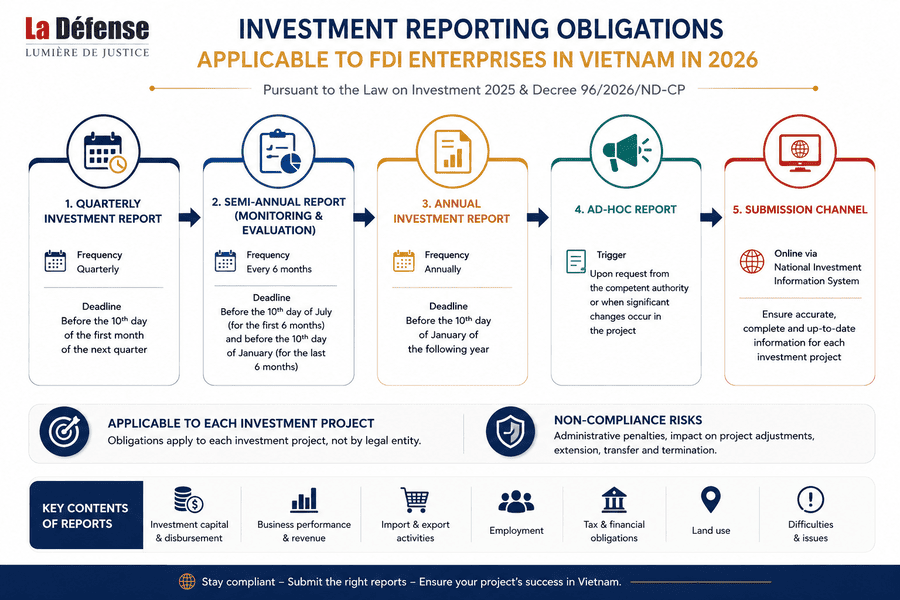
For enterprises operating multiple investment projects, the reporting obligation is generally imposed on each individual project, rather than on the enterprise as a whole. This distinction is often overlooked by investors managing multiple projects under a single legal entity.
III. What Information Must Be Reported?
Under the Law on Investment 2025 and Decree No. 96/2026/ND-CP, investment reports are intended to reflect the actual implementation status of the project.
The reports generally include information relating to:
- Project implementation progress;
- Registered capital and investment capital actually contributed;
- Business performance and revenue;
- Import and export turnover;
- Employment and workforce utilization;
- Tax and other financial obligations payable to the State;
- Land and water surface utilization;
- Difficulties, obstacles, and issues affecting project implementation.
These indicators provide the legal basis for competent authorities to assess project performance and to consider future applications for project amendments, extension of implementation schedules, project transfers, or project termination.
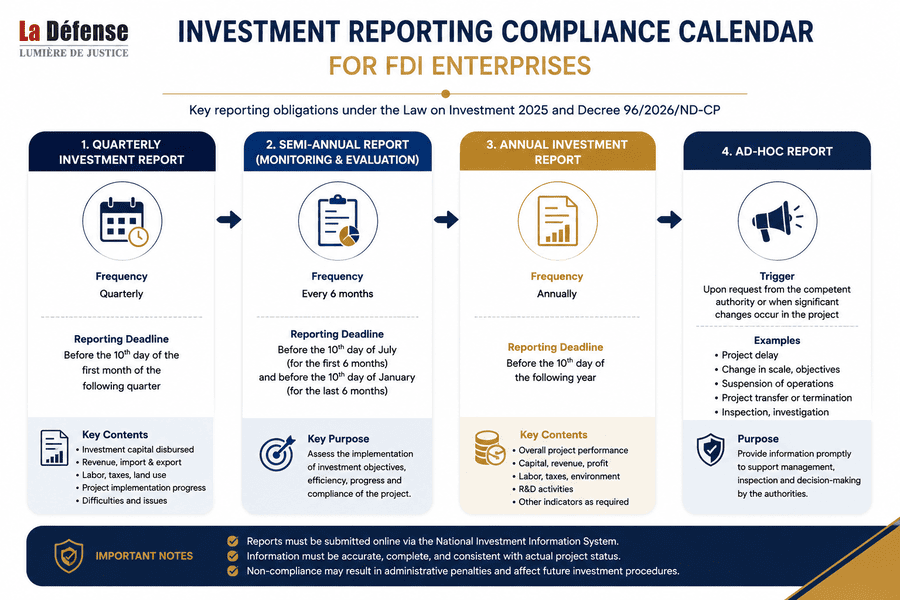
IV. Types of Investment Reports That Enterprises Should Pay Attention To
Quarterly Investment Reports
Investment project owners are required to submit quarterly reports on the implementation status of their projects.
Quarterly reports provide the authorities with updated information on the project’s progress during each reporting period, enabling continuous supervision of project implementation.
Timely submission is therefore essential to demonstrate ongoing compliance.
Annual Investment Reports
In addition to quarterly reporting, investors are also required to submit annual investment reports covering a broader range of information relating to the overall implementation of the project during the fiscal year.
Annual reports provide a comprehensive assessment of project performance and compliance.
Investment Monitoring and Evaluation Reports
This is one of the reporting obligations most frequently overlooked by enterprises.
Unlike regular investment activity reports, investment monitoring and evaluation reports focus on assessing the implementation of project objectives, investment efficiency, project progress, and overall effectiveness.
In practice, many enterprises submit quarterly reports but inadvertently fail to comply with this separate reporting obligation.
Ad-hoc Reports
Apart from periodic reporting, enterprises may also be required to submit ad-hoc reports upon request by competent authorities.
Such requests commonly arise where a project:
- experiences implementation delays;
- undergoes significant adjustments;
- suspends operations;
- changes investment objectives or scale;
- is subject to inspection or investigation; or
- is preparing for project termination or transfer.
Investors should therefore maintain complete and up-to-date project records rather than waiting until an official request is issued.
V. Why Has Investment Reporting Become Increasingly Important?
Vietnam’s investment management framework has gradually shifted from paper-based administration to a digital and data-driven regulatory system.
Today, investment authorities manage projects through the National Investment Information System, where project information is continuously updated and can be cross-checked with tax, customs, land administration, labor, and other governmental databases.
As a result, inconsistencies or omissions in investment reporting can now be identified much more efficiently than before.
Consequently, investment reporting is no longer viewed as an isolated administrative procedure but as an integral part of regulatory supervision.
VI. Legal Risks of Failing to Submit Investment Reports
Unlike certain licensing obligations, failure to submit investment reports may not produce immediate legal consequences.
This often creates a false sense of security among enterprises.
However, deficiencies usually become apparent when the enterprise subsequently seeks to:
- amend its Investment Registration Certificate (IRC);
- extend the project implementation schedule;
- adjust project objectives or investment scale;
- transfer the investment project;
- transfer capital contributions;
- terminate the investment project; or
- dissolve the foreign-invested enterprise.
In such circumstances, the investment authority will typically review the project’s historical compliance, including whether statutory reports have been duly submitted.
Failure to comply with reporting obligations may also expose the enterprise to administrative penalties under Vietnamese law.
More importantly, incomplete reporting records may adversely affect the authority’s assessment of the project’s implementation status, thereby complicating future investment procedures.
VII. How Should FDI Enterprises Manage This Compliance Obligation?
Investment reporting should not be treated as a year-end administrative task.
Instead, enterprises should incorporate reporting obligations into their overall legal compliance management system.
Each investment project should have its own compliance calendar, clearly identifying reporting deadlines, responsible personnel, and internal procedures for collecting and verifying project data.
The information included in investment reports should remain consistent with the enterprise’s accounting records, tax declarations, customs documentation, employment records, and investment files.
For enterprises operating multiple projects or multiple business locations, establishing a structured reporting system from the outset can significantly reduce legal risks during project amendments, inspections, transfers, or project termination.
Conclusion
Although investment reporting may appear to be a routine administrative requirement, it has become one of the most important indicators of an investor’s legal compliance under Vietnam’s modern investment regulatory framework.
As Vietnam continues to digitalize investment administration and strengthen data integration among government agencies, maintaining accurate, complete, and timely investment reports is no longer simply a statutory obligation—it is a fundamental component of corporate governance and legal risk management.
For foreign investors, a well-managed reporting system not only ensures ongoing regulatory compliance but also facilitates future investment activities, including project expansion, restructuring, transfer, or termination.
In today’s regulatory environment, investment reporting should no longer be viewed as a periodic filing obligation. It should be regarded as an essential element of sound investment governance and long-term legal compliance in Vietnam.
Read more relevant articles:
- Tax Tips for Small Businesses in Vietnam to Avoid Mistakes (2026 Guide)
- How to Start a Small Business in Vietnam (Step-by-Step) – 2026 Guide
- FDI Enterprises and the Private Sector Question: An Emerging Interpretative Risk in Vietnam’s Tax Incentive Framework
- FDI Entry Strategy in Vietnam under the 2025 Investment Law: Choosing Between Greenfield Investment and MandA