

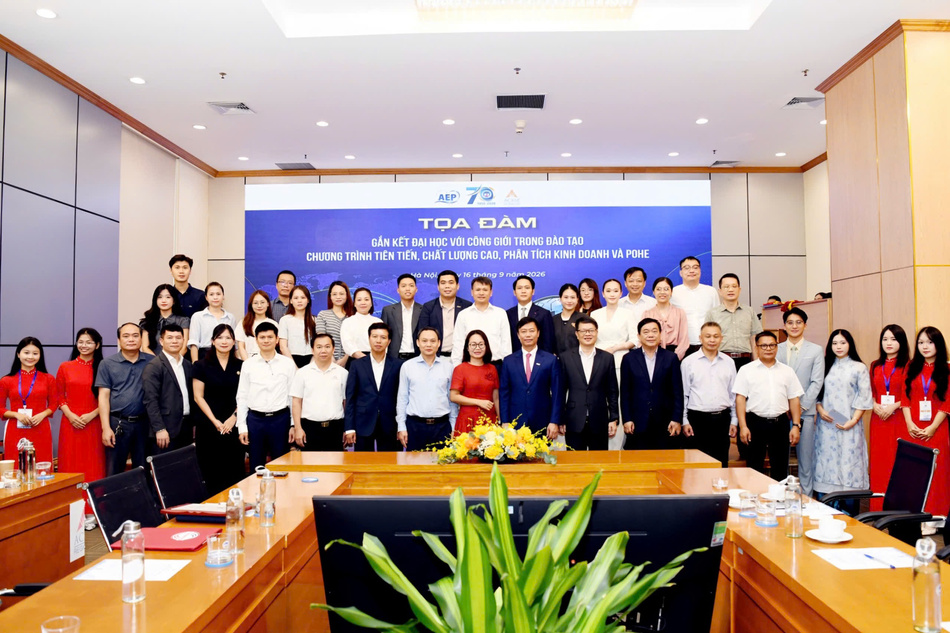
On 16 September 2026, La Défense Law Firm participated in the seminar entitled Strengthening University–Industry Linkages in the Delivery of Advanced, High-Quality, Business Analytics and POHE Programmes, organised by the National Economics University (NEU).
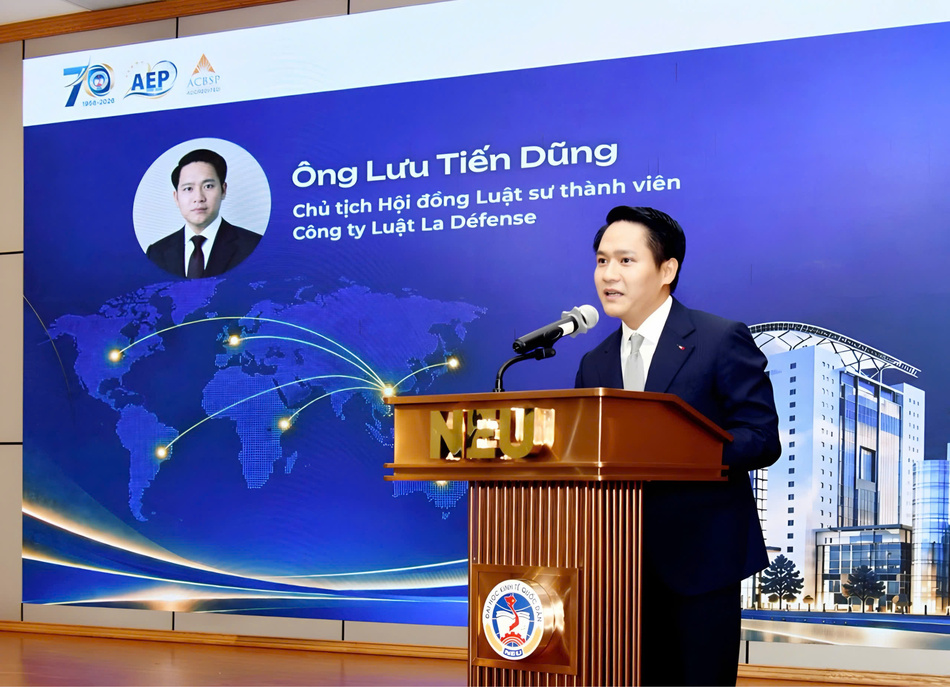
As part of the programme, Lawyer Luu Tien Dzung – Chairman of the Members’ Council of La Défense Law Firm – delivered a presentation on University–Enterprise Engagement in POHE Training and, on behalf of La Défense, entered into a training cooperation agreement with the National Economics University.
La Défense’s participation in the seminar reflected a broader approach to the role of professional organisations in human-resource development: businesses and professional service providers should not merely receive graduates at the end of the education process, but may also contribute directly to the development of students’ professional capabilities while they are still at university.
Bringing the requirements of professional practice into higher education
The seminar was held as the National Economics University continues to strengthen the involvement of enterprises, professional associations, public authorities and other stakeholders in its education and training activities, particularly within its Advanced, High-Quality, Business Analytics and POHE programmes.
These programmes are designed not only to provide students with a solid academic foundation, but also to develop practical competence, applied thinking and the ability to adapt to actual working environments. From this perspective, engagement with enterprises, professional organisations and public-sector institutions is an important mechanism for incorporating real-world requirements into curriculum development and programme delivery.
In his opening remarks, Assoc. Prof. Dr. Bui Huy Nhuong, Vice President of the National Economics University, emphasised the importance of developing substantive forms of cooperation between the University and the professional community, ranging from curriculum development and professional exposure to internships, recruitment and the effective utilisation of graduates.
The seminar brought together representatives from the leadership of the National Economics University and the Institute of Advanced, High-Quality and POHE Education, as well as representatives of government agencies, professional associations and the business community.
The presentations addressed university–industry cooperation from a range of perspectives, including corporate governance, professional associations, public administration and professional services. Within this framework, Mr. Luu Tien Dung represented La Défense as one of the speakers contributing a practitioner’s perspective to the discussion.
La Défense’s perspective: from legal knowledge to professional competence
Under the theme University–Enterprise Engagement in POHE Training, Mr. Luu Tien Dung’s presentation examined university–enterprise cooperation from the perspective of a professional legal services organisation.
This perspective is particularly relevant to profession-oriented higher education because legal practice illustrates clearly the distinction between possessing legal knowledge and having the professional capacity to resolve real-world issues faced by businesses, institutions and clients.
In legal practice, knowing and understanding statutory provisions is only the starting point. A lawyer or legal professional must also be capable of identifying the central legal issues within a complex set of facts, conducting and verifying legal research, assessing evidence and factual information, understanding the client’s commercial objectives, identifying legal and regulatory risks, developing practical options, drafting legal documents, negotiating effectively, and presenting and defending legal positions.
From La Défense’s perspective, such capabilities cannot be fully developed through lectures and textbooks alone. Students need structured exposure to practical situations, professional working methods and ethical standards during the course of their university education.
Accordingly, cooperation between universities and enterprises in the context of POHE should not be understood merely as arranging an internship at the end of an academic programme. Its greater value lies in establishing a continuous education process in which professional experience is brought into the classroom and academic knowledge is tested and further developed through practical problems.
Enterprises as partners in the education process
From La Défense’s standpoint, university–enterprise cooperation can be developed more effectively when enterprises participate more deeply in different stages of the education process.
Practising lawyers and other professionals can contribute practical case studies, participate in specialist seminars, support case-based learning, provide feedback on expected graduate competencies, and help students become familiar with professional working environments.
Through this process, students can move beyond merely observing professional work and begin to develop a practitioner’s method of thinking: receiving and analysing a problem, asking the right questions, identifying missing information, researching the applicable legal framework, assessing risks and developing appropriate solutions.

This is particularly significant in the field of economic and business law, where legal practice is increasingly intertwined with investment, corporate governance, commercial transactions, finance, employment, intellectual property and dispute resolution. Legal professionals therefore cannot approach legal issues in isolation from the commercial and operational context in which those issues arise.
La Défense’s cooperation with the National Economics University is intended, among other things, to create opportunities for students to visit and experience a professional legal environment, undertake internships and practical training, engage with appropriate real-life legal situations subject to confidentiality requirements, participate in professional discussions, and receive career orientation and professional networking opportunities.
Under this model, an enterprise is no longer merely the end user of graduates produced by the university, but becomes an active partner in developing the professional capabilities of future graduates.
Preparing future legal professionals for AI and digital transformation
Another significant aspect of La Défense’s approach concerns the impact of artificial intelligence and technological change on the legal profession.
AI is already changing the way lawyers search for information, conduct legal research, review contracts, process documents and analyse large volumes of data. At the same time, the increasing use of technology heightens the importance of professional capabilities for which human lawyers remain ultimately responsible, including source verification, assessment of reliability, identification of errors or bias, protection of confidential information and the exercise of independent legal judgment.
For La Défense, legal education in this new environment should not treat technology and traditional legal skills as competing alternatives. Students need to learn how to use technology as a tool for improving efficiency while also understanding its limitations and recognising the professional responsibility associated with relying on technology-generated outputs.
The involvement of law firms and enterprises in the education process can therefore provide universities with an additional mechanism for keeping pace with changes occurring in the marketplace—changes that may develop more quickly than the conventional cycle of curriculum review and amendment.
From professional discussion to substantive cooperation between La Défense and NEU
A notable aspect of the seminar on 16 September 2026 was that the discussion on university–industry engagement was translated into concrete cooperation arrangements.
Following the presentations and discussions, the National Economics University entered into cooperation agreements with participating organisations and enterprises. These agreements marked a transition from discussion and policy proposals to more structured commitments for future collaboration in education, practical training and human-resource development.
Within this framework, La Défense Law Firm and the National Economics University signed a Memorandum of Understanding on training cooperation, with Mr. Luu Tien Dung representing La Défense in the signing.
The agreement provides a basis for the two parties to develop cooperation in education, professional practice, research and human-resource development. For La Défense, the partnership is not simply a relationship with a higher education institution; it also creates an opportunity for practising lawyers to contribute directly to the preparation of the next generation of legal professionals.
Through internship programmes, professional exchanges, case-study work and career orientation activities, students may gain more systematic exposure to the realities of legal practice. At the same time, La Défense may engage with young talent at an earlier stage, identify students with strong professional potential and provide the University with feedback on emerging requirements within the legal services market.
The relationship is therefore reciprocal. The University provides academic foundations, research methodology and analytical discipline; professional organisations contribute practical experience, working methods and direct insight into the evolving demands of the market.
A long-term approach to professional responsibility
For La Défense, participation in education should not be viewed solely through the lens of recruitment.
The legal profession operates within a broader ecosystem comprising universities, professional organisations, public authorities, businesses, the legal community and future generations of practitioners. Over the long term, the quality of the legal services market is closely connected to the quality of professional education and to the environment in which young people first encounter the profession.
Against this background, the participation of practising lawyers in sharing knowledge, experience and professional standards with students may also be regarded as part of the legal profession’s broader responsibility for its own sustainable development.
Building on the cooperation agreement with NEU, La Défense intends to involve its lawyers and professionals in specialist exchanges, practical training, case-study development and initiatives enabling students to gain meaningful exposure to professional legal work. The cooperation also creates a foundation for future research activities, thematic seminars, internships and career connections.

Bringing the classroom and the professional world closer together
The seminar on 16 September 2026 demonstrated that university–industry engagement is increasingly being viewed not merely as an ancillary component of higher education, but as an integral part of the education process itself.
This is particularly important in the context of POHE – Profession-Oriented Higher Education – where the objective is not only to transmit academic knowledge, but also to develop professional capabilities that can be applied effectively in practice.
La Défense’s participation—from the presentation delivered by Mr. Luu Tien Dzung to the signing of the training cooperation agreement with the National Economics University—represents a practical step towards implementing that approach.
By strengthening the connection between academia and professional practice, students can gain a clearer understanding of their future professions before formally entering the workforce; universities can obtain more direct feedback from the market; and professional organisations can contribute to the development of the human resources that the market itself will require in the years ahead.
For La Défense, this cooperation also reflects a broader commitment to bringing professional legal practice into the academic environment while bringing students closer to the realities of professional work, thereby contributing to the development of a new generation of legal professionals with strong academic foundations, practical judgment, technological adaptability and a clear understanding of professional responsibility.