

Vietnam’s Law on Investment 2025, effective from March 1, 2026, represents one of the most significant regulatory shifts in the country’s investment landscape over the past decade. Rather than introducing isolated amendments, the new framework reflects a broader policy direction: facilitating market entry while strengthening post-investment supervision, improving transparency, and aligning Vietnam more closely with international investment practices.
For foreign investors, these changes are not merely technical. They directly affect how investments are structured, how quickly projects can be implemented, and how compliance risks are managed throughout the lifecycle of an investment. This article provides a strategic overview of the most important updates under the 2025 Investment Law that foreign investors should carefully consider when entering or expanding in Vietnam.
A Fundamental Shift in Regulatory Approach
One of the most notable developments under the new law is the transition from a pre-approval heavy system to a more flexible, facilitative regime. Historically, foreign investors were required to navigate multiple layers of approval before establishing a business. This often resulted in extended timelines and uncertainty during the initial phase of investment.
The 2025 framework introduces a more balanced model. Administrative procedures at the entry stage are streamlined, while regulatory oversight is increasingly focused on the operational phase. This means that investors can access the market more efficiently, but must maintain stricter compliance once their business is established.
This shift aligns Vietnam with global best practices, where regulatory systems prioritize ease of doing business without compromising governance and accountability.
Greater Flexibility in Investment Structuring
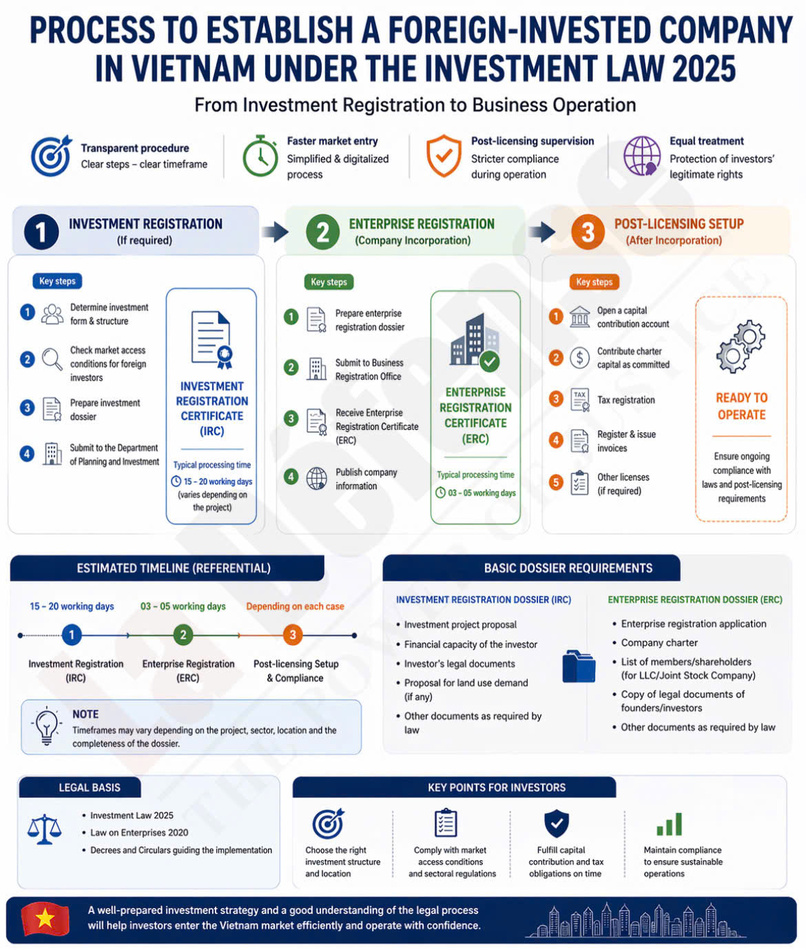
Another critical update lies in the increased flexibility regarding investment structuring. Under previous regulations, foreign investors were generally required to obtain an Investment Registration Certificate (IRC) before establishing a company.
In 2026, the application of this requirement has become more nuanced. In certain cases—particularly where the investment does not involve complex conditions or large-scale projects—investors may adopt more flexible sequencing between investment approval and company incorporation.
This creates new opportunities for structuring investments in a way that optimizes both timing and regulatory efficiency. However, it also requires a deeper understanding of when an IRC is mandatory and how different structures may affect compliance obligations
Enhanced Transparency in Market Access Conditions
The 2025 Investment Law introduces significant improvements in the transparency of market access conditions for foreign investors. Previously, identifying applicable restrictions could be complex, as conditions were scattered across various legal instruments.
The new framework consolidates and clarifies these conditions, making it easier for investors to assess whether a particular business activity is permitted and under what terms. This includes clearer guidance on foreign ownership limits, licensing requirements, and sector-specific restrictions.
For investors, this transparency reduces uncertainty and allows for more accurate feasibility assessments at an early stage of project planning. It also supports more strategic decision-making in selecting business sectors and investment structures.
Refinement of Conditional Business Lines
Vietnam continues to maintain a system of conditional business sectors, where specific requirements must be met before a company can operate. However, the 2025 law refines this system by removing outdated conditions and simplifying regulatory requirements.
The focus is now on ensuring that conditions are necessary, proportionate, and clearly defined, rather than serving as administrative barriers. This not only improves the business environment but also enhances regulatory consistency.
For foreign investors, understanding whether a business falls within a conditional sector—and what specific requirements apply—remains a critical step in the investment process.
Introduction of Special Investment Procedures
The new legal framework introduces mechanisms often referred to as fast-track or special investment procedures, designed to accelerate the approval process for certain projects.
These procedures are typically applied to investments that align with national priorities, such as high technology, innovation, infrastructure, or environmentally sustainable development. Eligible projects may benefit from shorter processing times and more streamlined administrative requirements.
This development signals Vietnam’s intention to actively attract strategic investments that contribute to long-term economic transformation.
Strengthened Post-Licensing Compliance and Supervision
While entry procedures have been simplified, the 2025 law places greater emphasis on post-licensing compliance. Authorities are increasingly focused on monitoring business operations to ensure that investors adhere to legal and regulatory requirements.
This includes obligations related to investment reporting, financial transparency, environmental compliance, and adherence to approved project parameters. Non-compliance can result in administrative sanctions or, in serious cases, revocation of investment approvals.
For investors, this means that compliance should be treated as an ongoing process integrated into daily operations, rather than a one-time requirement during the establishment phase.
Digitalization of Investment Procedures
A key feature of the 2026 investment environment is the integration of digital platforms into administrative processes. Investment registration, enterprise incorporation, and regulatory reporting are increasingly conducted through electronic systems.
This digital transformation enhances efficiency, reduces processing time, and improves transparency. It also allows investors to track the status of their applications more easily and interact with authorities in a more structured manner.
However, digitalization also increases the importance of accuracy and consistency in documentation, as discrepancies can be identified more quickly by regulatory systems.
Alignment with Strategic Economic Priorities
The 2025 Investment Law reflects Vietnam’s broader economic strategy, which prioritizes innovation, sustainability, and high-value industries. Investment incentives and policy support are increasingly directed toward sectors such as technology, renewable energy, and advanced manufacturing.
For foreign investors, aligning their projects with these strategic priorities can provide significant advantages, including access to incentives, faster approval processes, and stronger institutional support.
This alignment is particularly important in a competitive investment environment, where governments actively compete to attract high-quality capital.
Practical Implications for Foreign Investors
The changes introduced by the 2025 Investment Law have several practical implications for foreign investors operating in Vietnam.
First, the investment process is becoming more efficient, allowing for faster market entry. Second, the regulatory framework is more transparent, enabling better-informed decision-making. Third, compliance obligations are more structured, requiring investors to adopt a proactive and systematic approach to governance.
These developments create both opportunities and responsibilities. Investors who understand and adapt to the new framework will be better positioned to succeed, while those who rely on outdated assumptions may face challenges.
Key Takeaways from Vietnam’s Investment Law 2025
Vietnam’s Investment Law 2025 marks a significant evolution in the country’s regulatory landscape, reflecting a shift toward a more modern, transparent, and investor-friendly system.
The most important changes include the simplification of entry procedures, greater flexibility in investment structuring, improved transparency in market access conditions, and a stronger focus on post-licensing compliance. These reforms are designed to facilitate investment while ensuring that business activities are conducted in a responsible and sustainable manner.
For foreign investors, the new framework offers substantial opportunities to enter and expand in Vietnam more efficiently. However, it also requires a more sophisticated approach to legal planning and compliance management. A clear understanding of these changes is essential to maximizing investment potential and minimizing regulatory risks.
La Défense – Strategic Legal Partner for Investment in Vietnam
At La Défense, we support foreign investors in navigating Vietnam’s evolving investment framework with clarity and strategic insight. Our services cover the full spectrum of foreign direct investment, from market entry strategy and investment structuring to licensing, compliance, and dispute resolution.
Our strength lies in combining deep legal expertise with a practical, business-oriented approach, enabling us to deliver solutions that are both legally sound and commercially effective. We understand that each investment project presents unique challenges, and we tailor our advice to align with our clients’ objectives and risk profiles.
With extensive experience in cross-border transactions and regulatory advisory, La Défense is well-positioned to assist investors in capitalizing on opportunities and managing complexities in Vietnam’s dynamic market.
Disclaimer
The information provided in this article is for general informational and reference purposes only. It reflects the legal framework as of 2026 and does not constitute official legal advice, professional legal opinion, or a substitute for individualized legal counsel. Laws and regulations in Vietnam are subject to frequent changes, and the application of these rules may vary depending on the specific circumstances of each investment project.
We strongly recommend that you consult our experienced FDI lawyers or qualified legal advisors for a detailed assessment, risk analysis, and tailored solutions that best suit your business objectives and specific situation.
Read more other articles:
- Vietnam Economic Outlook 2026: Strategic Guide for Foreign Investors
- Foreign Ownership below 50% in Vietnamese Companies: Is M&A Approval Required and Does the Company Qualify as an FDI Enterprise?
- What options exist in Vietnam for restructuring an insolvent company and protecting creditors&interests?
- Legal Compliance for Foreign-Owned Company in Vietnam