

Vietnam continues to position itself as one of the most attractive destinations for foreign direct investment in Asia, supported by strong macroeconomic fundamentals, a competitive labor market, and a progressively modernized legal framework. With the Law on Investment 2025 and its guiding instruments taking effect in 2026, the regulatory landscape has undergone meaningful changes that directly impact how foreign investors establish and operate businesses in Vietnam.
This guide provides a structured, practical overview of how to set up a foreign company in Vietnam in 2026, focusing on legal conditions, market access rules, procedural steps, and compliance obligations. It also highlights key reforms that reshape investment strategies and reduce administrative barriers, while maintaining regulatory oversight.

Understanding Market Access and Investment Conditions
The starting point for any foreign investor is determining whether the intended business activity is legally permitted and, if so, under what conditions. Vietnam maintains a negative list approach, meaning foreign investors are free to invest in sectors not expressly restricted. However, certain industries remain either prohibited or subject to conditional market access.
In practice, most challenges arise not from outright prohibitions but from conditional sectors, where investors must satisfy requirements relating to ownership ratios, licensing thresholds, or operational qualifications. These conditions are often embedded in sector-specific regulations and may vary depending on whether the investor operates independently or through a joint venture with a Vietnamese partner.
The 2026 legal framework reflects a more transparent approach to market access. Conditions are increasingly codified and published, allowing investors to assess feasibility at an earlier stage. This is particularly relevant for sectors such as education, logistics, retail, and digital services, where regulatory scrutiny remains relatively high.
Choosing the Right Business Structure
Selecting an appropriate corporate structure is a critical strategic decision. For most foreign investors, the limited liability company (LLC) remains the preferred vehicle due to its flexibility and relatively simple governance framework. It allows full foreign ownership in many sectors and limits liability to the contributed capital.
In contrast, the joint stock company (JSC) is more suitable for larger projects or businesses that anticipate future capital raising, including public offerings. While it offers greater flexibility in transferring shares, it also involves more complex governance requirements.
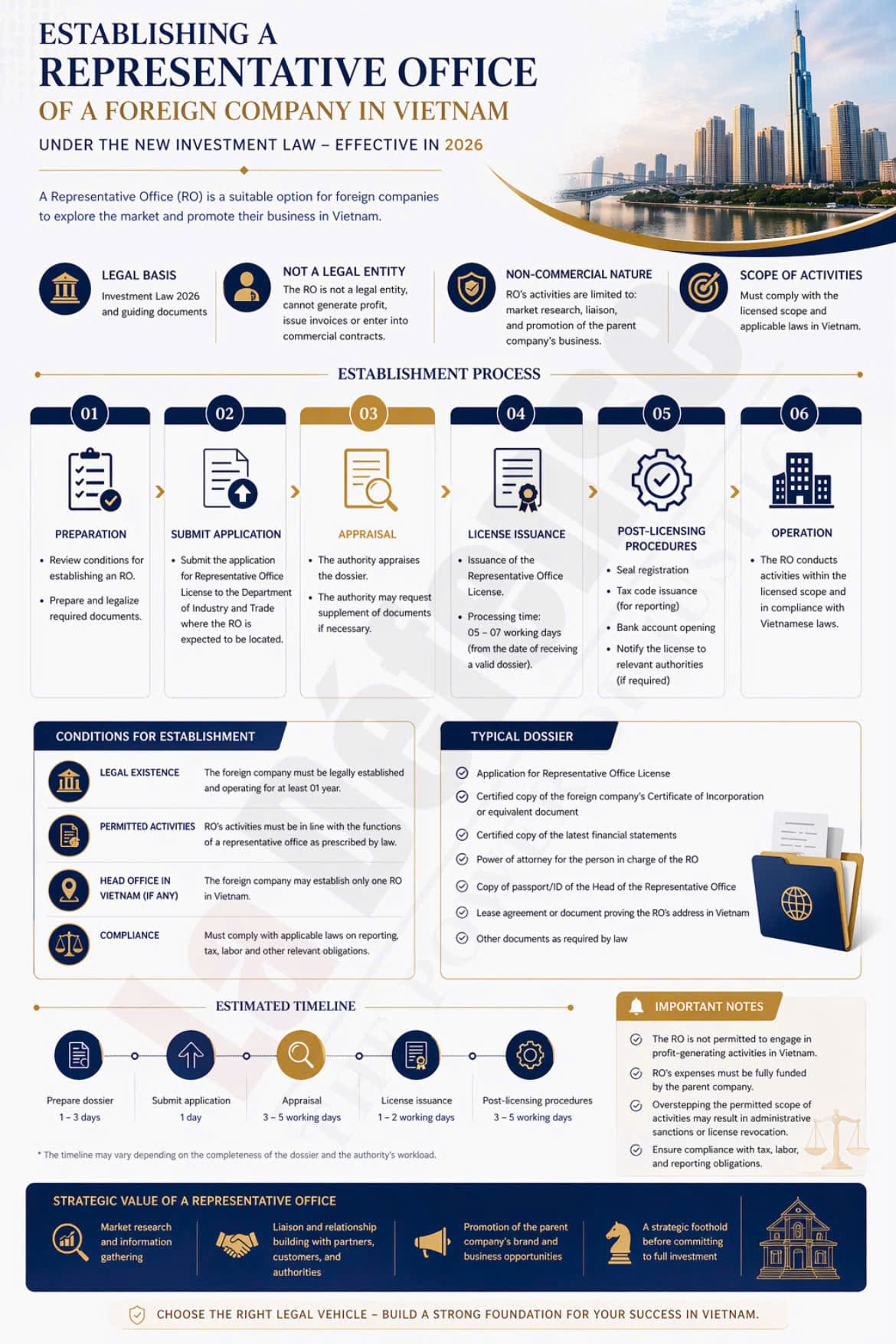
Other forms, such as representative offices or branch offices, serve limited purposes. A representative office cannot generate revenue and is typically used for market research or liaison activities, while a branch is only permitted in specific sectors and operates as a dependent unit of the parent company.
The choice of structure should be aligned with long-term business objectives, taking into account regulatory conditions, capital requirements, and exit strategies.
Investment Registration and the Shift in Regulatory Approach
One of the most notable changes under the 2026 framework is the evolving role of the Investment Registration Certificate (IRC). Traditionally, foreign investors were required to obtain an IRC before establishing a company, effectively treating investment approval as a prerequisite for market entry.
However, recent reforms introduce a more flexible approach. In certain cases, investors may proceed with company incorporation before completing all investment-related procedures, particularly where the business does not involve complex regulatory conditions. This reflects a broader policy shift toward facilitating investment while strengthening post-establishment supervision.
Despite this flexibility, the IRC remains relevant for projects involving land use, large-scale investments, or regulated sectors. Authorities will assess compliance with planning regulations, market access conditions, and financial capacity before granting approval. Investors should therefore carefully evaluate whether their project falls within the scope requiring an IRC to avoid delays or legal complications.
Enterprise Registration and Company Formation
Once the investment framework is clarified, the next step is obtaining the Enterprise Registration Certificate (ERC), which legally establishes the company. This process involves submitting foundational documents such as the company charter, shareholder information, and details of the legal representative.
The incorporation process in 2026 is increasingly streamlined, supported by digitalization and administrative reforms. Online submission systems and electronic signatures are now widely accepted, reducing processing time and enhancing transparency. For straightforward cases, company registration can be completed within a relatively short period.
The ERC serves as the legal basis for the company’s existence, enabling it to enter into contracts, open bank accounts, and conduct business operations in Vietnam.
Licensing for Conditional Business Activities
For businesses operating in conditional sectors, additional licenses must be obtained before commencing operations. These sector-specific approvals are often the most time-consuming aspect of the setup process, as they require detailed documentation and, in some cases, technical or financial qualifications.
The 2026 regulatory updates aim to reduce unnecessary barriers by simplifying licensing procedures and removing outdated conditions. However, the practical application still depends on the interpretation of local authorities, which means that careful preparation and strategic planning remain essential.
Investors should also be aware of transitional provisions, as some regulatory changes are implemented gradually. This creates both opportunities and risks, particularly for projects initiated during the transition period.
Taxation and Financial Compliance
Vietnam’s tax system is relatively straightforward but requires strict compliance. Foreign-invested companies are subject to corporate income tax (CIT), value-added tax (VAT), and personal income tax (PIT) for employees.
Upon incorporation, companies must register with the tax authority, obtain a tax identification number, and establish an accounting system in accordance with Vietnamese standards. The adoption of electronic invoicing and digital tax administration has significantly improved efficiency, but it also increases the level of scrutiny applied to financial transactions.
Tax incentives are available for certain sectors and geographic areas, particularly those aligned with national development priorities such as high technology, renewable energy, and infrastructure. However, accessing these incentives requires careful structuring and ongoing compliance.
Labor and Employment Regulations
Labor compliance is a key aspect of operating a business in Vietnam. The legal framework governs employment contracts, working conditions, social insurance, and employee rights. Employers are required to formalize employment relationships through written contracts and register employees for mandatory insurance contributions.
For foreign companies, hiring expatriate employees involves additional procedures, including obtaining work permits and appropriate visas. While the process is relatively standardized, it requires coordination with multiple authorities and adherence to strict timelines.
Vietnam’s workforce remains one of its most competitive advantages, but companies must ensure compliance with labor regulations to avoid disputes and administrative penalties.
Corporate Governance and Legal Representation
Every company in Vietnam must appoint at least one legal representative, who acts on behalf of the company in legal and administrative matters. This individual holds significant responsibility, including signing contracts and representing the company before authorities.
The governance structure varies depending on the type of entity. In an LLC, decision-making authority typically rests with the members’ council or the owner, while a JSC operates through a more complex system involving a board of directors and shareholders’ meetings.
Foreign investors should pay particular attention to the appointment of the legal representative, especially in cross-border structures where control and accountability must be clearly defined.
Post-Establishment Compliance and Regulatory Trends
The most significant shift in Vietnam’s 2026 investment framework is the emphasis on post-licensing supervision. While entry procedures have been simplified, regulatory authorities now focus more on monitoring ongoing compliance.
Companies are required to fulfill various reporting obligations, including investment reports, tax filings, and labor declarations. Failure to comply can result in administrative sanctions or operational disruptions.
This approach aligns Vietnam with international regulatory practices, where ease of entry is balanced by stricter enforcement during operation. For investors, this means that compliance should not be viewed as a one-time requirement but as an ongoing process integrated into business operations.
Key Legal Developments Affecting Foreign Investors in 2026
The reforms introduced in 2026 are not merely procedural adjustments but reflect a broader transformation of Vietnam’s investment environment. The legal framework now emphasizes flexibility, transparency, and alignment with global standards.
One of the most notable developments is the introduction of fast-track or green channel procedures for certain types of projects, allowing for expedited approval processes. This is particularly relevant for investments in strategic sectors such as technology and innovation.
Another important change is the increased use of digital platforms in administrative procedures. From company registration to tax compliance, digitalization reduces processing time and enhances predictability for investors.
At the same time, the government continues to refine market access conditions, ensuring that foreign investment contributes to sustainable economic development while maintaining national interests.
Practical Considerations for Investors
Setting up a foreign company in Vietnam requires not only an understanding of legal procedures but also a strategic approach to risk management. Common challenges include misinterpreting market access conditions, underestimating licensing requirements, and failing to align corporate documentation.
Investors should also consider the importance of local practice, as the interpretation and implementation of regulations can vary depending on the authority involved. Engaging experienced legal advisors can significantly reduce risks and ensure a smoother setup process.
Vietnam’s investment landscape in 2026 presents a compelling opportunity for foreign investors, supported by progressive legal reforms and a pro-business policy direction. The process of establishing a company has become more accessible, with streamlined procedures and greater flexibility in investment structuring.
However, the regulatory framework remains nuanced, particularly in areas such as conditional business lines, market access, and post-establishment compliance. A well-planned approach that combines legal insight with practical execution is essential to successfully navigate the market.
For international investors, Vietnam offers not only growth potential but also a legal environment that is increasingly aligned with global standards—making it a strategic destination for long-term investment.
Disclaimer:
The information provided in this article is for general informational and reference purposes only. It reflects the legal framework as of 2026 and does not constitute official legal advice, professional legal opinion, or a substitute for individualized legal counsel. Laws and regulations in Vietnam are subject to frequent changes, and the application of these rules may vary depending on the specific circumstances of each investment project.
We strongly recommend that you consult our experienced FDI lawyers or qualified legal advisors for a detailed assessment, risk analysis, and tailored solutions that best suit your business objectives and specific situation.
Read more other articles:
- Vietnam Business Ideas 2026: Top Sectors & Legal Guide
- Business Structures for Foreign Investors in Vietnam: Complete 2026 Guide – LLC, JSC, Branch, Representative Office & More
- The Growing Demand for Private Legal Counsel Among Business Owners in Vietnam
- Vietnam’s Legal Overhaul: Paving the Way for International Business