

Vietnam continues to be one of the most attractive foreign direct investment (FDI) destinations in Southeast Asia in 2026. With a GDP growth rate consistently above 6.5%, a young and dynamic workforce of over 100 million people, strategic geographic location, and strong integration into global trade agreements (CPTPP, EVFTA, RCEP, and US-Vietnam Comprehensive Strategic Partnership), the country offers tremendous opportunities for foreign investors.

The year 2026 marks a major milestone in Vietnam’s investment environment. The Law on Investment 2025 (No. 143/2025/QH15), effective from 1 March 2026, and the Amended Law on Enterprises 2025, effective from 1 July 2025, have introduced the most significant reforms in over a decade. Key improvements include the reversed licensing sequence (ERC before IRC), substantial reduction in conditional business lines, enhanced digital procedures, and clearer Ultimate Beneficial Owner (UBO) disclosure rules.
This comprehensive 2026 guide (over 3,000 words) provides foreign investors with everything they need to know about opening a company in Vietnam — from strategic planning and legal structures to step-by-step procedures, costs, timelines, compliance requirements, common pitfalls, and expert recommendations.
Why Open a Company in Vietnam in 2026? Key Advantages
- Reformed licensing process: Many investors can now obtain the Enterprise Registration Certificate (ERC) first, allowing early bank account opening and operational preparation.
- Reduced conditional sectors: 38 business lines fully liberalized and over 20 narrowed effective 1 July 2026.
- Attractive incentives: Extended tax holidays, preferential tax rates, land rental exemptions, and fast-track approvals in high-tech, semiconductor, renewable energy, and R&D sectors.
- Digital transformation: Nearly all procedures are handled online through the National Business Registration Portal and National Investment Portal.
- Strong economic fundamentals: Stable politics, improving infrastructure, and growing domestic middle class.
1. Choosing the Right Business Structure for Foreign Investors in 2026
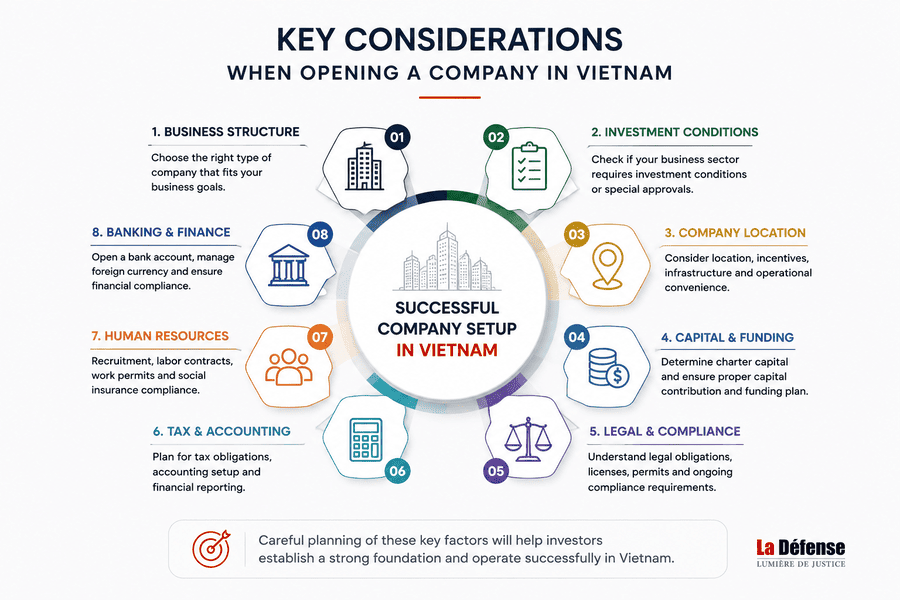
Selecting the appropriate legal form is one of the most critical decisions.
| Business Structure | Foreign Ownership | Minimum Members/Shareholders | Legal Personality | Best Suitable For | Setup Time (2026) | Liability |
| Single-Member LLC | 100% | 1 | Yes | Most FDI projects, wholly foreign-owned | 4–8 weeks | Limited |
| Multi-Member LLC | 100% | 2–50 | Yes | Partnerships with local or multiple owners | 5–9 weeks | Limited |
| Joint Stock Company (JSC) | 100% | 3+ | Yes | Large projects, IPO plans, capital raising | 6–12 weeks | Limited |
| Representative Office (RO) | 100% | N/A | No | Market research & liaison only | 2–4 weeks | Parent company |
| Branch Office | 100% (restricted) | N/A | No | Logistics, banking, specific services | 8–14 weeks | Parent company |
| Business Cooperation Contract (BCC) | Contract-based | N/A | No new entity | Infrastructure, oil & gas, short-term | 4–10 weeks | Contractual |
Recommendation: For the vast majority of foreign investors, a 100% foreign-owned Limited Liability Company (LLC) is the best choice due to its flexibility, simplicity, limited liability, and ease of management.
2. Detailed Step-by-Step Process to Open a Company in Vietnam in 2026
Step 1: Pre-Investment Preparation (1–3 weeks)
- Conduct thorough market research and feasibility study.
- Select precise VSIC codes (Vietnam Standard Industrial Classification – 2026 updated version).
- Check market access conditions under Vietnam’s WTO commitments and the new Investment Law appendices.
- Secure a legal business address (physical office lease or Memorandum of Understanding – virtual offices are increasingly accepted).
- Prepare and legalize all investor documents (passport, Certificate of Incorporation, board resolution, etc.).
- Draft detailed Investment Project Proposal and Business Plan.
Step 2: Enterprise Registration Certificate (ERC) – The New Fast-Track Option
- Submit application online via the National Business Registration Portal (dangkykinhdoanh.gov.vn).
- Processing time: 3 working days (standard cases).
- Upon approval, you receive:
- Enterprise Registration Certificate
- Tax identification number (TIN)
- Official company status
This is one of the biggest improvements in 2026 — you can now legally exist as a company before full investment approval.
Step 3: Investment Registration Certificate (IRC)
- Submit to the Department of Planning and Investment (DPI) or Management Board of Industrial/Economic Zones.
- Standard processing: 15 working days
- Conditional or large-scale projects: up to 35 working days
- Real average time in 2026: 20–28 days
Step 4: Post-Registration Procedures (2–4 weeks)
- Engrave company seal and digital signature.
- Open Direct Investment Capital Account (DICA) at a commercial bank.
- Register for electronic invoicing (mandatory).
- Register with social insurance, health insurance, and labor authorities.
- Contribute charter capital within 90 days from ERC issuance (strictly enforced).
- Apply for additional sector-specific licenses (if applicable).
Step 5: Operational Readiness
- Obtain work permits and temporary residence cards for foreign employees.
- Implement accounting software compliant with Vietnamese standards.
- Set up internal governance documents (Company Charter, Internal Regulations, Shareholder Agreements).
Total Timeline Summary (2026):
- Simple service/trading company: 4–7 weeks
- Manufacturing or conditional sector: 8–14 weeks
- Large-scale or high-tech project: 3–6 months
3. Required Documents – 2026 ChecklistInvestor Documents:
- Notarized and legalized passport / corporate documents + Vietnamese translation.
- Proof of financial capacity (bank statements, audit reports).
- Power of Attorney (if using a law firm).
Company Documents:
- Application forms for ERC and IRC.
- Company Charter (detailed governance rules).
- List of members/shareholders and UBO declaration.
- Investment Project Proposal.
- Office lease agreement or MOU.
- Undertaking letter on compliance with market access conditions.
All documents must be submitted electronically.
4. Capital Requirements and Contribution Rules
- No general minimum charter capital for most sectors in 2026.
- Conditional sectors still require minimum capital (e.g., real estate development, education, banking, logistics).
- Contribution deadline: 90 days from ERC date — late contribution incurs penalties up to 0.03%/day + possible license revocation.
- Capital can be contributed in cash, assets, or intellectual property.
5. Tax, Incentives and Financial Considerations in 2026
Corporate Income Tax (CIT): 20% standard rate.
-
- Preferential rates: 10% for 15 years (high-tech, semiconductor).
- 15% for 10 years (renewable energy, large agriculture processing).
- VAT: 10% standard, temporary 8% reduction until end of 2026 for many sectors.
- Personal Income Tax (PIT) for expatriates: Progressive 5–35%, with expanded exemptions on housing and school fees.
- Strong investment incentives: Tax exemption 2–4 years + 50% reduction for next 9 years in encouraged sectors and locations.
New in 2026: BEPS Pillar Two 15% minimum tax applies to large multinational groups.
6. Post-Establishment Compliance & Ongoing Obligations
- Ultimate Beneficial Owner (UBO) Disclosure: Mandatory declaration and update within 10 days of changes.
- Annual financial audit and tax finalization (90 days after fiscal year-end).
- Monthly/Quarterly tax declarations via electronic portal.
- Labor compliance: Work permits for foreigners, labor contracts, and social insurance.
- Foreign exchange control: All capital transactions through authorized banks.
7. Costs of Opening and Operating a Company in Vietnam (2026 Estimates)
- Legal & consulting fees: USD 2,500 – 6,500
- Government & licensing fees: USD 300 – 800
- Office setup & deposit: USD 3,000 – 15,000+
- Initial accounting & compliance setup: USD 1,200 – 2,500
- Total first-year cost (excluding charter capital): USD 8,000 – 25,000 depending on complexity.
8. Common Pitfalls Foreign Investors Face in 2026
- Missing the strict 90-day capital contribution deadline.
- Choosing incorrect or too narrow VSIC codes.
- Underestimating post-licensing requirements (especially e-invoicing and UBO disclosure).
- Using risky nominee director structures (now heavily scrutinized).
- Poor due diligence on business address and partners.
- Ignoring sector-specific additional licenses.
9. Special Considerations for Different Industries
- Manufacturing & High-tech: Strong incentives but environmental impact assessment required.
- Trading & Distribution: Import/export licenses often needed.
- Education & Healthcare: Additional operating licenses and facility standards.
- IT & Digital Services: Relatively straightforward with data localization considerations.
10. How Professional Support Can Save Time and Reduce Risk
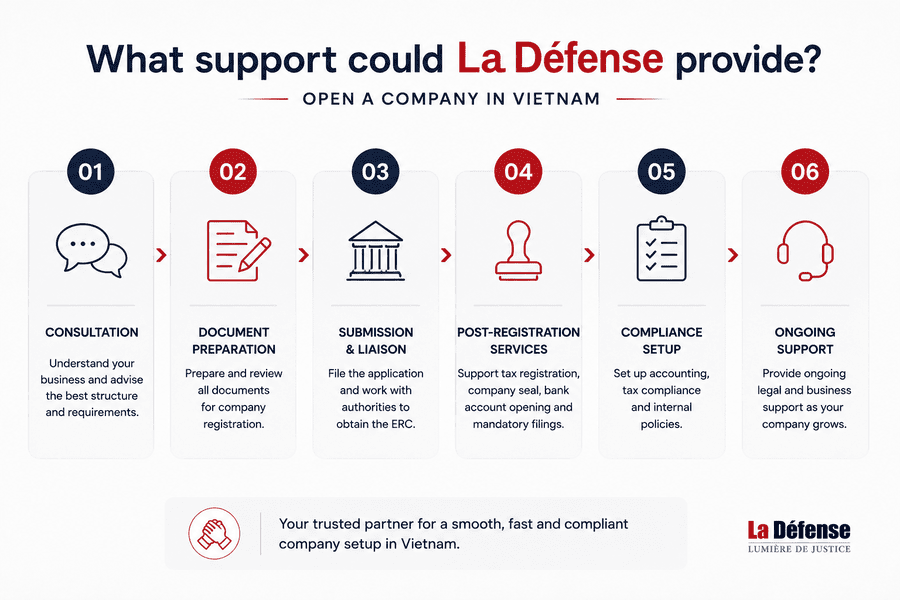
Working with an experienced FDI law firm can reduce setup time by 30–50% and significantly lower compliance risks. Professional services typically include document legalization, business line classification, application drafting, government liaison, and post-setup support.
Ready to Open Your Company in Vietnam?
2026 offers one of the best windows in recent years for foreign investors to establish a presence in Vietnam. The legal framework is clearer, procedures are faster, and incentives remain highly competitive.
Our specialized team of FDI lawyers and former government officials has successfully assisted hundreds of foreign investors in setting up companies across all major sectors. We provide end-to-end support — from initial planning to full operational handover.
Contact us today for a free, no-obligation 45-minute consultation. We will analyze your project, recommend the optimal structure, and provide a detailed timeline and cost estimate tailored to your industry and objectives.
This is the flagship article in our 2026 FDI Series for Foreign Investors in Vietnam.
Related Articles:
- Nominee Director Vietnam: Legal Risks and Safer Alternatives (2026 Guide)
- Top 10 Conditional Sectors Still Requiring Extra Licenses After July 2026: Essential Guide for Foreign Investors in Vietnam
- Vietnam Business Ideas 2026: Top Sectors & Legal Guide
- Tax Tips for Small Businesses in Vietnam to Avoid Mistakes (2026 Guide)
- Home Ownership for Foreigners in Vietnam (2026 Guide)
The information in this article is for general reference only and reflects the legal framework as of 2026. It does not constitute official legal advice. Laws and regulations can change, and the best solution depends on your specific circumstances.
We strongly recommend consulting our experienced FDI lawyers for tailored guidance and a comprehensive risk assessment.