

Vietnam enters 2026 with one of the most compelling growth stories in Asia, combining strong economic momentum with an increasingly investor-friendly legal framework. Following a robust expansion of over 8% in 2025, the country is transitioning into a new phase characterized by structural reforms, digital transformation, and strategic repositioning in global supply chains.
For international investors, understanding Vietnam’s GDP growth trajectory is not merely a macroeconomic exercise. It is a practical foundation for identifying sectors with the highest return potential, assessing regulatory risks, and designing long-term investment strategies in a rapidly evolving market.

Vietnam’s GDP Growth Trajectory: From Recovery to Expansion
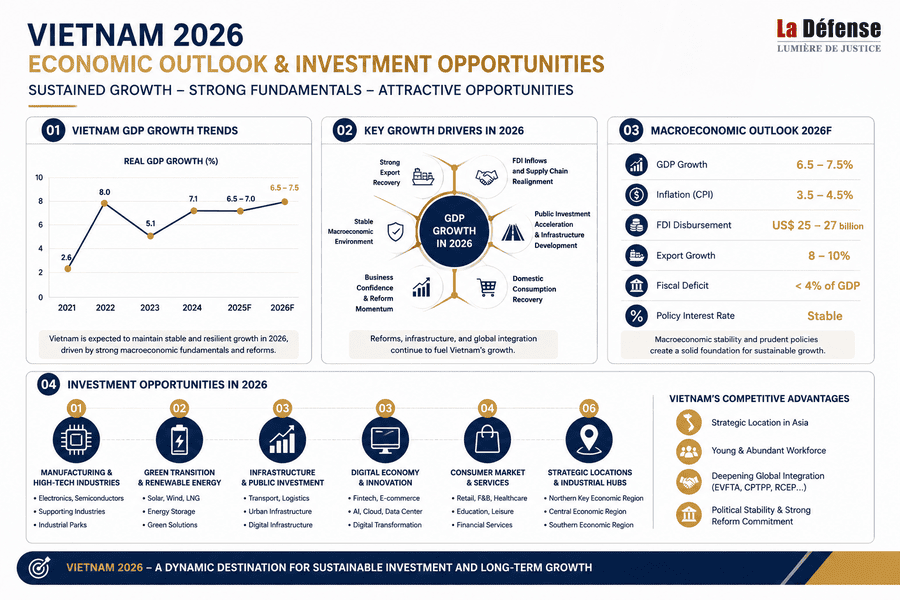
Vietnam’s recent economic performance reflects a remarkable recovery and acceleration phase. The economy grew approximately 8.02% in 2025, placing it among the fastest-growing economies globally and reinforcing its position as a regional growth leader.
In 2026, growth is expected to remain strong but slightly moderated due to external pressures. Forecasts vary depending on institutions, but most converge within a stable range. The Asian Development Bank projects growth at around 7.2%, while the World Bank adopts a more conservative estimate of approximately 6.3%, still among the highest in the Asia-Pacific region.
Short-term data confirms this resilience. In the first quarter of 2026, Vietnam recorded GDP growth of 7.83% year-on-year, demonstrating continued expansion despite global uncertainties and rising energy costs.
This combination of strong baseline growth and controlled moderation signals a transition from rapid recovery to sustainable, policy-driven expansion.
Key Drivers Behind Vietnam’s Economic Growth
Vietnam’s growth model in 2026 is supported by a balanced combination of domestic demand, export performance, and structural transformation.
Export-Led Growth and Global Supply Chain Integration
Exports remain a central pillar of Vietnam’s economy. Double-digit export growth in early 2026 reflects the country’s deep integration into global manufacturing networks, particularly in electronics, textiles, and industrial production.
Vietnam continues to benefit from the reconfiguration of global supply chains, as multinational corporations diversify production away from traditional hubs. This trend has elevated Vietnam into a strategic manufacturing and logistics center in Southeast Asia.
Rising Domestic Consumption
Domestic demand is emerging as a powerful complementary driver. Retail sales growth exceeding 10% indicates strong consumer confidence and rising income levels.
The expansion of the middle class, combined with urbanization and digital adoption, is reshaping Vietnam into a consumption-driven economy rather than one solely dependent on exports.
Public Investment and Infrastructure Development
Government-led infrastructure investment plays a critical role in sustaining growth momentum. Large-scale projects in transportation, energy, and urban development are designed to improve connectivity and unlock regional economic potential.
Vietnam’s strategic focus on infrastructure is not only a domestic growth driver but also a key factor attracting foreign capital, particularly in logistics and industrial real estate.
Resilient Foreign Direct Investment (FDI)
FDI inflows remain strong, supported by investor confidence in Vietnam’s stability and reform trajectory. In early 2026, realized foreign investment continued to grow, while registered capital increased significantly, reflecting long-term commitments from international investors.
Vietnam’s ability to maintain consistent FDI growth, even amid global volatility, highlights its structural competitiveness and policy credibility.
Structural Transformation and Economic Upgrading
Beyond short-term growth, Vietnam’s economy is undergoing a deeper transformation that creates new investment opportunities.
Shift Toward High-Value Industries
The government is actively promoting sectors such as technology, semiconductors, digital services, and renewable energy. This shift aims to move Vietnam up the global value chain, reducing dependence on low-cost manufacturing.
The transition is supported by targeted incentives and regulatory reforms, particularly under the Law on Investment 2025, which prioritizes high-tech and innovation-driven projects.
Digital Economy Expansion
Vietnam’s digital economy is expanding rapidly, driven by e-commerce, fintech, and data-driven services. The integration of digital technologies across industries is enhancing productivity and creating new business models.
This trend is particularly attractive to foreign investors seeking scalable, technology-enabled opportunities in emerging markets.
Urbanization and Industrialization
Rapid urbanization continues to fuel demand for infrastructure, housing, and services. At the same time, industrial zones and economic corridors are expanding, creating new hubs for manufacturing and logistics.
These structural shifts provide a strong foundation for sustained growth beyond 2026.
Investment Opportunities in Vietnam (2026)
Vietnam’s economic dynamics translate into diverse investment opportunities across multiple sectors.
Manufacturing and Industrial Production
Manufacturing remains the cornerstone of Vietnam’s investment landscape. The country’s competitive labor costs, improving infrastructure, and favorable trade agreements make it an ideal destination for export-oriented production.
High-growth segments include electronics, automotive components, and precision engineering, particularly as Vietnam positions itself within global technology supply chains.
Technology and Innovation
Technology-driven sectors represent one of the most promising areas for investment. The government’s policy direction encourages innovation in artificial intelligence, software development, and digital platforms.
Vietnam’s young, tech-savvy population provides a strong talent base, while regulatory reforms aim to facilitate investment in emerging industries.
Infrastructure and Energy
Infrastructure development continues to attract significant capital, particularly in transportation and energy. Renewable energy projects, in particular, are gaining momentum as Vietnam seeks to balance economic growth with sustainability.
Public-private partnerships are increasingly used to mobilize investment, creating opportunities for foreign investors to participate in large-scale projects.
Consumer and Retail Markets
The expansion of the middle class is driving demand for consumer goods, retail services, and lifestyle products. This trend is particularly evident in urban areas, where consumption patterns are rapidly evolving.
Foreign brands entering Vietnam benefit from a growing market with increasing purchasing power and openness to international products.
Financial and Professional Services
As the economy becomes more complex, demand for financial, legal, and professional services is rising. This creates opportunities for foreign firms to provide advisory, compliance, and investment services tailored to both domestic and international clients.
Legal and Policy Environment: A Catalyst for Investment
Vietnam’s economic performance is closely linked to its evolving legal framework. The reforms taking effect in 2026 play a critical role in shaping investment decisions.
Transition to a More Flexible Investment Regime
The new legal framework reflects a shift toward facilitating market entry while strengthening post-licensing supervision. Administrative procedures have been streamlined, reducing entry barriers for investors.
This approach aligns Vietnam with international best practices, where ease of entry is combined with ongoing compliance monitoring.
Improved Market Access Transparency
Market access conditions for foreign investors are increasingly codified and publicly available. This reduces uncertainty and allows investors to assess regulatory feasibility at an early stage.
The clarification of sector-specific conditions is particularly important for industries such as retail, logistics, and education.
Digitalization of Administrative Procedures
The adoption of digital platforms for investment registration, tax compliance, and corporate reporting enhances efficiency and transparency.
This digital transformation not only reduces processing time but also improves predictability for investors navigating the regulatory system.
Risks and Challenges in 2026
Despite strong growth prospects, Vietnam faces several challenges that investors should carefully consider.
External Economic Pressures
Vietnam’s export-oriented economy makes it vulnerable to global demand fluctuations. Rising energy costs and geopolitical uncertainties have already begun to impact growth dynamics in early 2026.
Inflation and Cost Pressures
Inflation is expected to increase moderately, driven by higher energy prices and domestic demand. While still manageable, rising costs may affect profitability in certain sectors.
Regulatory Implementation Variability
Although legal reforms aim to simplify procedures, the practical application of regulations can vary depending on local authorities. This requires investors to adopt a proactive and well-informed compliance strategy.
Strategic Outlook for Investors
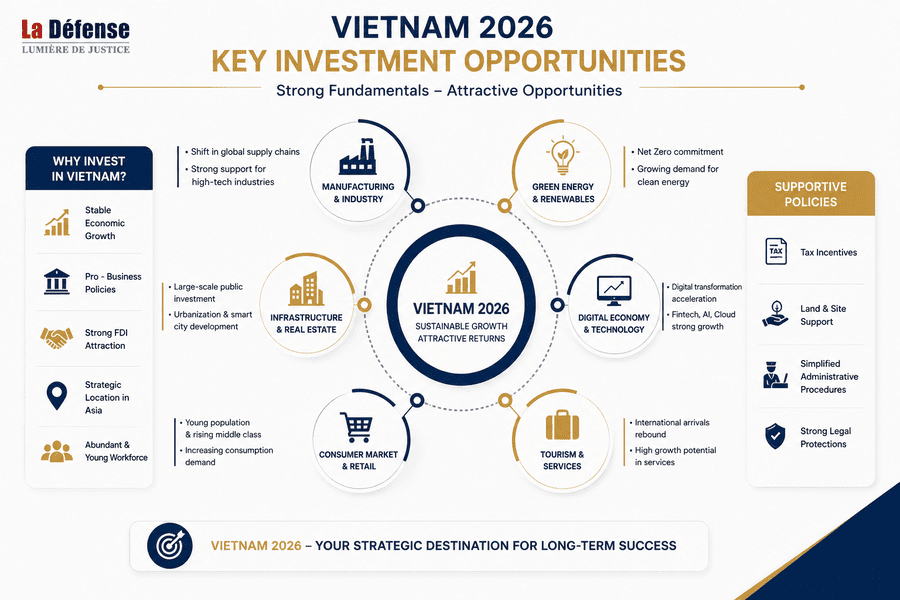
Vietnam’s economic outlook for 2026 and beyond remains highly positive, supported by strong fundamentals and proactive policy measures. The government’s long-term ambition to achieve higher growth rates reflects a commitment to accelerating economic transformation and attracting global investment.
For foreign investors, the key to success lies in aligning investment strategies with Vietnam’s structural trends. Sectors linked to technology, infrastructure, and consumption are likely to offer the most significant opportunities, while traditional manufacturing continues to provide stable returns.
At the same time, navigating the regulatory environment requires a nuanced understanding of both legal frameworks and local practices. Strategic planning, combined with professional advisory support, is essential to maximize opportunities and mitigate risks.
Brief Conclusion
Vietnam in 2026 stands at a pivotal moment in its economic development. Strong GDP growth, supported by structural reforms and strategic investments, creates a favorable environment for foreign investors seeking long-term opportunities in Asia.
While external challenges and regulatory complexities remain, the overall trajectory is clear: Vietnam is evolving into a more sophisticated, innovation-driven economy with increasing global integration.
For international investors, this represents not only a growth opportunity but also a chance to participate in one of the most dynamic economic transformations in the region.
Disclaimer
The information provided in this article is for general informational and reference purposes only. It reflects the legal framework as of 2026 and does not constitute official legal advice, professional legal opinion, or a substitute for individualized legal counsel. Laws and regulations in Vietnam are subject to frequent changes, and the application of these rules may vary depending on the specific circumstances of each investment project.
We strongly recommend that you consult our experienced FDI lawyers or qualified legal advisors for a detailed assessment, risk analysis, and tailored solutions that best suit your business objectives and specific situation.
Read more relevant articles:
- How to Open a Company in Vietnam: Complete 2026 Guide for Foreign Investors
- How Do I Start a Business in Vietnam? Guide for Foreign Investors 2026
- Investment in Vietnam through Business Cooperation Contracts (BCC): Legal Framework and Key Notes for Foreign Investors
- Vietnam for Business 2026: Strategy Guide for Investors
- Key Updates in Vietnam’s Investment Law 2025: What Foreign Investors Must Know