

Vietnam continues to be one of Asia’s most attractive FDI destinations in 2026. With stable economic growth, strategic location in global supply chains, and a young, skilled workforce, the country drew over USD 38 billion in registered FDI in 2024 alone. For foreign investors, 2026 marks a pivotal year: the Law on Investment 2025 (No. 143/2025/QH15) took effect on 1 March 2026, bringing the most significant procedural reforms in over a decade.
This updated guide walks you through exactly how to start a business in Vietnam as a foreign investor in 2026 — with clear, practical steps, the latest legal changes, timelines, costs, and critical pitfalls to avoid. Whether you are planning a 100% foreign-owned LLC, a manufacturing plant, or a service company, this article equips you with the actionable insights you need right now.

1. Why Start a Business in Vietnam in 2026? The Big Picture for FDI
- Investor-friendly reforms: The new Investment Law reverses the traditional licensing sequence, reduces conditional business lines by 38 sectors (effective 1 July 2026), and narrows another 20+ sectors.
tractus-asia.com +1
- Faster market entry: You can now incorporate your company before obtaining project approval in many cases.
- Strong incentives: Tax breaks (up to 4 years exemption + 9 years 50% reduction), land rental preferences in industrial zones, and high-tech/semiconductor priorities remain robust.
- Digital & transparent procedures: Most applications are now submitted online via the National Business Registration Portal.
Key takeaway for 2026: The window to enter Vietnam has never been wider — but only if you understand the new sequencing and market-access rules.
2. Choosing the Right Business Structure in 2026
| Structure | Foreign Ownership | Best For | Minimum Shareholders | Typical Setup Time |
| LLC (100% foreign-owned) | Up to 100% | Most investors (manufacturing, services, trading) | 1 member | 4–8 weeks |
| Joint Stock Company (JSC) | Up to 100% (subject to sector) | Companies planning IPO or large capital raise | 3 shareholders | 6–10 weeks |
| Representative Office | N/A | Market research & liaison only | N/A | 2–4 weeks |
| Branch (limited sectors) | 100% | Banking, insurance, logistics | N/A | 8–12 weeks |
Recommendation for most FDI clients: Start with a Limited Liability Company (LLC) — it offers full control, limited liability, and the simplest compliance path in 2026.
3. What’s New in 2026: Major Legal Changes You Must Know
The Law on Investment 2025 introduces three game-changing updates:
- Reversed licensing sequence (ERC before IRC possible)
Foreign investors can now obtain the Enterprise Registration Certificate (ERC) first, then apply for the Investment Registration Certificate (IRC). This lets you open a bank account, sign leases, hire staff, and record pre-investment expenses while your project is being approved. - 38 conditional business lines abolished (effective 1 July 2026)
Sectors such as certain tax/customs brokerage, insurance auxiliaries, employment services, data centers, study-abroad consulting, and architecture services are no longer “conditional.” This dramatically reduces sub-licenses and approval time.
- Streamlined investment policy approval
Only 20 specific project categories now require high-level approval (down from broader lists). Most standard FDI projects go directly to provincial DPI.
Pro tip: If your sector is still conditional after July 2026, you must still meet ownership caps, minimum capital, or professional certificates — but the overall burden is far lighter.
4. Step-by-Step Guide: How to Start a Business in Vietnam in 2026
Here is the practical 5-step process most foreign investors follow today:
Step 1: Pre-Investment Planning (1–2 weeks)
- Define exact VSIC business lines (use the new 2026 list).
- Check market access conditions (WTO commitments + new Investment Law appendices).
- Secure a virtual/physical address (office lease or MOU).
- Prepare investor documents (passport, corporate docs — notarized + legalized + translated).
Step 2: Obtain Enterprise Registration Certificate – ERC (New 2026 Option)
- Submit online via National Business Portal.
- Processing time: 3 working days (standard).
- You now receive a company tax code and legal status immediately.
Step 3: Obtain Investment Registration Certificate – IRC
- Apply to the Department of Planning and Investment (DPI) or industrial zone authority.
- Statutory time: 15 working days (standard) / 35 working days (conditional).
- Real-world 2026 average: 20–30 days.
Step 4: Post-Licensing Procedures (2–3 weeks)
- Carve company seal & digital signature.
- Open capital contribution account (Direct Investment Capital Account).
- Register for e-invoicing, labor, social insurance, and fire safety (if applicable).
- Contribute charter capital within 90 days of ERC issuance.
Step 5: Sector-Specific Licenses (if still required after July 2026)
Examples: Trading license (for distribution), education license, healthcare permit, etc.Total realistic timeline in 2026:
- Standard non-conditional project: 4–6 weeks
- Conditional sectors: 8–12 weeks
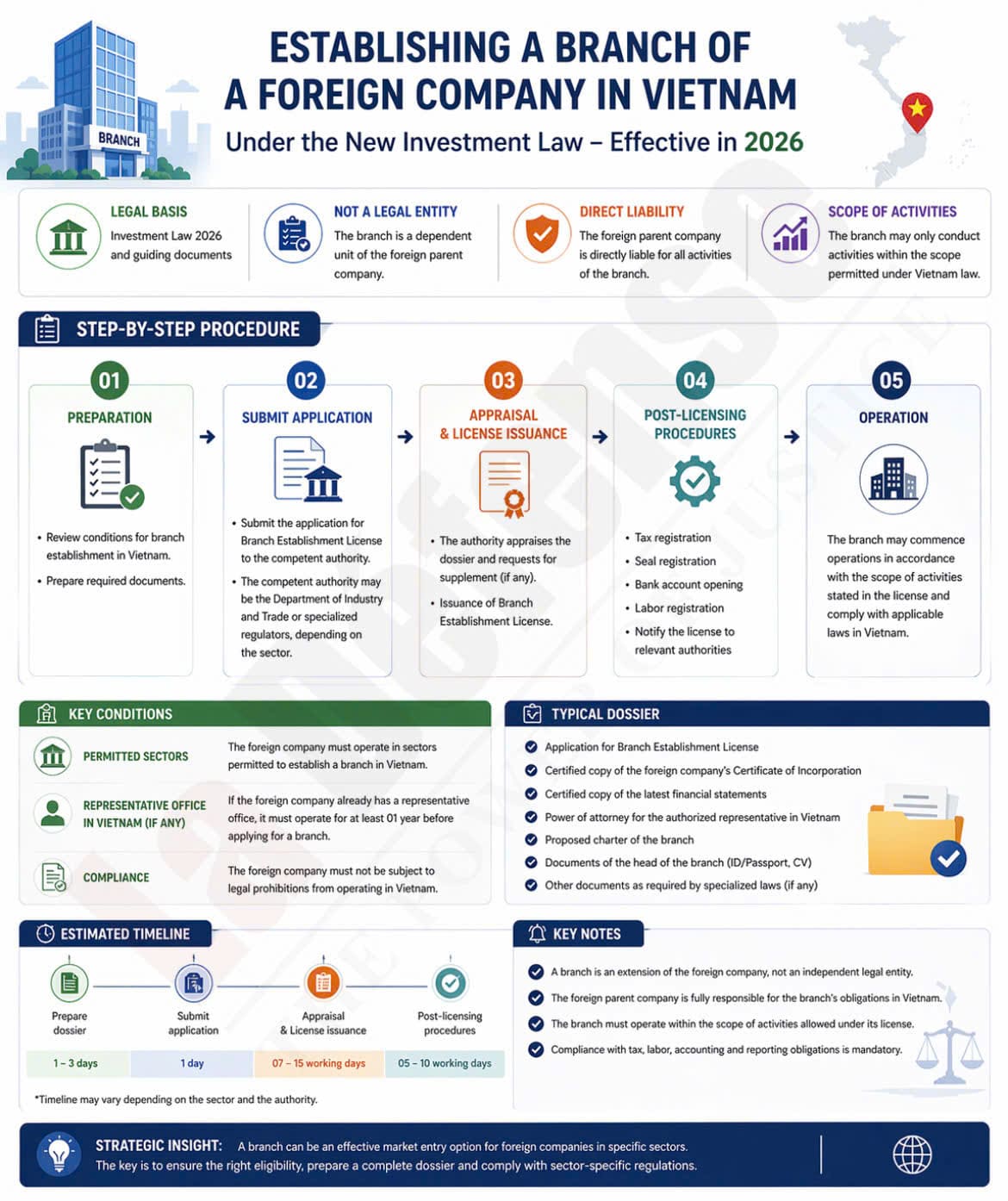
5. Documents You Will Need (2026 Checklist)
- Investor’s passport / corporate documents (legalized).
- Business plan / project proposal.
- Office lease agreement or MOU.
- Undertaking to comply with market access conditions (new requirement for ERC-first route).
- Power of attorney (if using a law firm).
6. Capital, Taxes & Incentives in 2026
- No general minimum charter capital (except specific conditional sectors like banking, real estate, education).
- Corporate Income Tax: Standard 20%; preferential rates 10–15% for high-tech, R&D, or encouraged zones.
- Capital contribution deadline: Strictly 90 days from ERC.
- Profit repatriation: Freely allowed after tax obligations and audited financials.
7. Common Pitfalls Foreign Investors Face in 2026 (and How to Avoid Them)
- Underestimating the 90-day capital contribution deadline → heavy fines.
- Choosing overly broad or narrow VSIC codes → costly amendments later.
- Ignoring the new ERC-first option → losing 2–3 weeks of setup time.
- Delaying post-licensing steps (bank account, e-invoice) → cannot invoice or operate legally.
Ready to Launch Your FDI Project in Vietnam in 2026?
Starting a business in Vietnam has never been faster or more predictable — provided you leverage the 2026 reforms correctly.
At our firm, we specialize in guiding foreign investors through the exact new procedures under the Law on Investment 2025 and Decree 96/2026/ND-CP. We handle everything from business-line screening and document legalization to full licensing and post-establishment compliance — often completing the entire process in under 6 weeks.
Contact us today for a free 30-minute consultation tailored to your industry and 2026 investment plan. Our team of investment lawyers and former DPI officers will map out the fastest, lowest-risk route for your specific project.
Stay ahead of the curve. Vietnam is open for business — make sure your entry is structured for success from day one.
____________________
The information provided in this article is for general informational and reference purposes only. It reflects the legal framework as of 2026 and does not constitute official legal advice, professional legal opinion, or a substitute for individualized legal counsel. Laws and regulations in Vietnam are subject to frequent changes, and the application of these rules may vary depending on the specific circumstances of each investment project.
We strongly recommend that you consult our experienced FDI lawyers or qualified legal advisors for a detailed assessment, risk analysis, and tailored solutions that best suit your business objectives and specific situation.
Read more other relavant articles:
- Vietnam for Business 2026: Strategy Guide for Investors
- How to Start a Small Business in Vietnam (Step-by-Step) – 2026 Guide
- Vietnam Tax Policy Updates 2026 – VAT, CIT, PIT, and Tax Administration: What FDI Investors Need to Know
- Labor Laws and Employment Compliance for FDI Businesses in Vietnam
- Complete Guide to Company Incorporation in Vietnam for 2026