

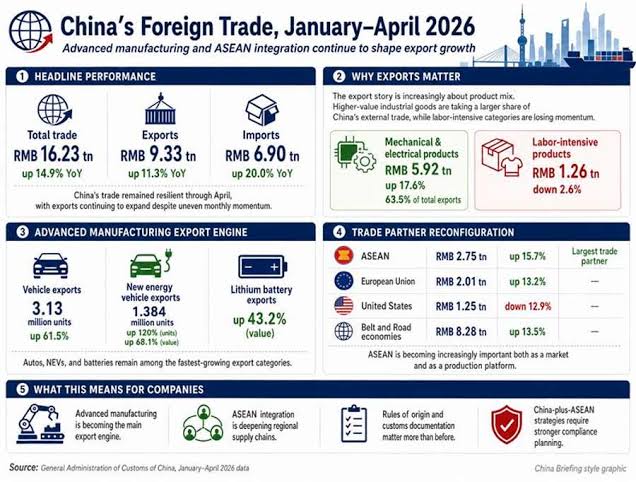
The expansion of Chinese goods and production networks across Southeast Asia has a dual impact on businesses in the region. Supplies of materials, components and machinery may reduce production costs, while competition from imported goods places domestic manufacturers under pressure in terms of prices and market share. These issues are addressed in the article “China’s Record Exports: A Test for ASEAN Businesses”, published on the VCCI Centre for WTO and International Trade’s information portal on 9 November 2026.
From a legal perspective, businesses must distinguish ordinary commercial competition from circumstances warranting trade remedy action. They must also verify compliance with origin requirements when using imported materials to manufacture goods for export. Supply chain restructuring should be supported by appropriate contractual arrangements governing costs, quality and access to evidence.

1. Increased Imports Do Not, in Themselves, Establish Unfair Trade Practices
A product may be priced below domestically manufactured goods because of economies of scale, technology, productivity or supply conditions. Price differences or import growth alone are therefore insufficient to establish dumping or subsidisation.
Under the WTO framework, anti-dumping, countervailing and safeguard measures are distinct mechanisms, each subject to its own conditions:
|
Mechanism |
Principal legal considerations |
| Anti-dumping measures | Establishing dumping, injury and a causal relationship in accordance with the applicable rules |
| Countervailing measures | Establishing countervailable subsidisation, injury and a causal relationship |
| Safeguard measures | Determining whether increased imports cause or threaten serious injury, together with the other applicable conditions |
Safeguard measures do not require proof of dumping or subsidisation. However, the injury standard and the other requirements governing safeguards must be assessed independently.
In our view, businesses facing competitive pressure should begin by identifying the underlying issue accurately. Where difficulties arise principally from productivity, cost structures or changes in demand, the legal assessment must account for those factors. Attributing the entire deterioration in business performance to imports may weaken the argument concerning causation.
2. Using Trade Remedies on the Basis of Domestic Industry Evidence
Viet Nam’s legal framework includes Decree No. 86/2025/NĐ-CP, effective from 1 July 2025, which details certain provisions of the Law on Foreign Trade Management concerning trade remedies. The Decree replaces Decree No. 10/2018/NĐ-CP and contains transitional provisions for the relevant proceedings.
Domestic manufacturers should not postpone preparation until their difficulties become severe. Relevant data should be monitored over time, including import volumes, selling prices, output, capacity utilisation, inventories, revenue and profitability.
In anti-dumping investigations, WTO rules require injury determinations to be based on positive evidence and an objective examination of import volumes, price effects and the resulting impact on the domestic industry.
In practice, businesses should separate data concerning the product concerned from their other activities. Aggregate financial statements may show declining profitability without explaining the extent of the impact on the particular product under consideration.
In our view, coordination through industry associations may assist in gathering information. Nevertheless, each enterprise remains responsible for the accuracy and verifiability of the data it provides. General market observations cannot replace evidence substantiating the industry’s position.
3. Importers and Industrial Users Should Manage Risk on a Product-Specific Basis
Increased Chinese supply may benefit businesses using imported materials or equipment. However, a low purchase price does not reflect the full legal and commercial cost of a transaction.
Businesses should establish whether the product is subject to an investigation or an existing trade remedy measure, identify the manufacturer, origin and technical characteristics accurately, and monitor decisions that may affect the consignment.
Case AD25 is a relevant recent development. On 6 November 2026, the Ministry of Industry and Trade initiated an anti-dumping investigation into certain cold-rolled stainless steel products originating in China, Indonesia and Taiwan (China). Initiation must be distinguished from a decision imposing measures.
This illustrates why exposure must be assessed by product and proceeding, rather than by assuming that all goods from a particular country are subject to the same treatment.
In our view, importers should maintain a monitoring list of potentially exposed products and conduct a review before placing substantial orders. Cost forecasts should distinguish liabilities arising under measures already in force from amounts included solely as risk scenarios.
4. Chinese Materials and the Limits of Preferential Origin Treatment
4.1. Cumulation Must Be Assessed under the Relevant Agreement
Chinese materials may be used in manufacturing in Viet Nam, but the finished product’s eligibility for preferential treatment depends on the applicable agreement and its product-specific rules.
For RCEP, Ministry of Industry and Trade guidance recognises the possibility of cumulating originating materials from member countries, subject to the applicable requirements and appropriate supporting documentation. Purchasing materials from a member country does not, by itself, establish that those materials qualify as originating.
An origin determination under RCEP cannot automatically be relied upon under the EVFTA or another agreement. Businesses should develop an origin assessment for each export market.
For example, a factory using the same materials for goods sold to several countries must assess the applicable criteria separately for each product line and preferential arrangement. Obtaining preferential treatment in one market does not establish entitlement in another.
4.2. Distinguishing Preferential Origin, Non-Preferential Origin and Anti-Circumvention Rules
These are related but distinct legal matters. Compliance with a preferential rule of origin does not, by itself, resolve every question concerning origin under the importing market’s law or the scope of an anti-circumvention measure.
Conversely, the use of Chinese materials does not automatically constitute origin fraud or circumvention. The assessment must consider the production process, supporting records and rules applicable to the particular circumstances.
In our view, businesses should maintain records capable of explaining their material sources, manufacturing operations, production capacity and origin determination. These records should be generated through ordinary operations rather than assembled only when verification is requested.
5. Production Relocation and Exposure to Anti-Circumvention Proceedings
Where sourcing or production activities are relocated to Viet Nam, both the commercial objectives and the legal consequences in the destination market must be assessed. Transshipment, packaging, processing and assembly may be treated differently depending on the applicable rules and the scope of the relevant measure.
The incorporation of an enterprise or establishment of a production facility in Viet Nam should not be treated as a general assurance that its products fall outside an investigation. Equally, not every project using Chinese inputs constitutes circumvention.
Before accepting orders or investing in production lines, businesses should determine whether the product is connected with measures in force in the importing market, the legal significance of the proposed operations, and the evidence available to substantiate actual production.
Viet Nam has also applied anti-circumvention measures in specific proceedings. In July 2026, the Trade Remedies Authority announced a decision imposing anti-circumvention measures on certain hot-rolled steel products originating in China.
This development demonstrates that changes to product characteristics or transaction arrangements must be assessed in terms of their legal substance, rather than merely their declared form.
6. Contractual Arrangements to Manage Supplier Dependence
Businesses relying on concentrated sources of supply should review their contracts against the possibility of disruption and cost changes. Priority matters include quality, inspection rights, origin documentation, delivery periods, changes in materials and remedies for non-conforming products.
For equipment and technology, the review should also address access to spare parts, operating data, maintenance services and software usage rights. A low initial purchase price may be offset by higher switching costs where the enterprise lacks the rights or information needed to engage an alternative supplier.
Contracts should also require cooperation with investigations or verification procedures. If a supplier cannot provide supporting records, the Vietnamese enterprise may face difficulties even where the relevant information arises from operations performed by that supplier.
In our view, supply diversification should be accompanied by standardised legal and documentary requirements for suppliers. Changing counterparties without improving records and contractual terms may simply reproduce the same exposure in a different form.
7. Recommended Approach for Vietnamese Businesses
Domestic manufacturers should monitor competition through reliable data and assess the availability of trade remedies where the legal conditions may be satisfied. Importers should manage product scope, costs and procedural obligations. Exporters should control origin compliance, production records and destination-market exposure.
These activities may coexist within the same enterprise. A decision to purchase lower-priced materials should therefore be considered alongside its implications for the origin of finished goods, the ability to substantiate compliance and contractual responsibilities.
From La Défense’s perspective, the benefits of competitively priced supply can be sustained only where businesses control the legal conditions governing the entire transaction. Reliable records, an accurate assessment of the applicable trade remedy framework and appropriate contractual arrangements will place enterprises in a stronger position to respond to changes in regional trade.
Read more other relevant articles:
- Investment Reporting Obligations in Vietnam: A Compliance Requirement That Every FDI Enterprise Should Not Overlook
- How to Open a Company in Vietnam: Complete 2026 Guide for Foreign Investors
- Outbound Investment under Decree 103/2026/ND-CP: When Liberalisation Comes with a New Layer of Control
- Investing and doing business in Hong Kong: a comprehensive legal guide for vietnamese investors
- Complete Guide to Company Incorporation in Vietnam for 2026