
When traceability becomes a condition for market access,
Changes in the European Union’s trade policy are placing new demands on Vietnam’s coffee industry in relation to supply chain transparency, the legality of production areas and accountability throughout the supply chain. As environmental standards increasingly become legally binding conditions for placing goods on the market, regulatory compliance is no longer solely a concern for individual exporters. It is directly linked to the industry’s ability to maintain access to its export markets.
According to figures published by the WTO and International Trade Centre of the Vietnam Chamber of Commerce and Industry (VCCI) on 19 October 2026, the EU accounted for 40.7% of Vietnam’s total coffee export value in 2025, equivalent to approximately USD 3.63 billion. As one of the most important export destinations for Vietnamese coffee, changes to the EU’s import requirements have significant implications for coffee production, procurement and export activities in Vietnam.
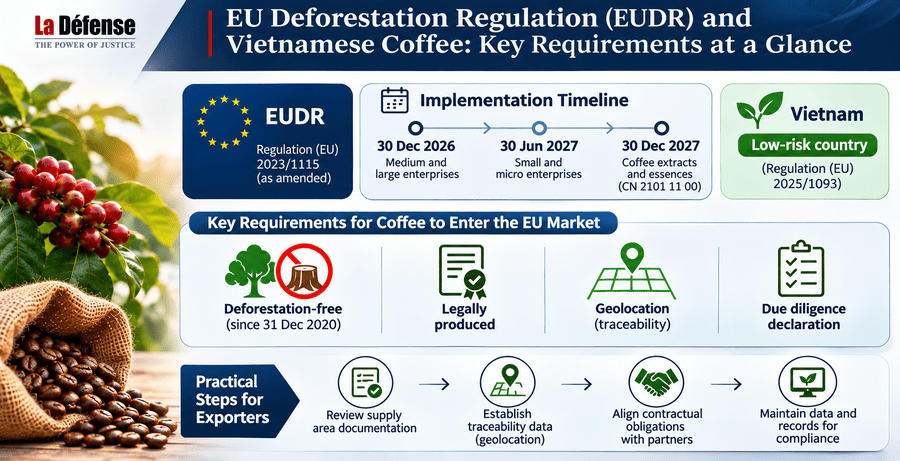
One of the most consequential regulatory developments is the EU Deforestation Regulation (EUDR), established under Regulation (EU) 2023/1115 and subsequently amended by relevant EU legislation, notably Regulation (EU) 2025/2650.
Under the current implementation timetable, the EUDR will apply from 30 December 2026 to medium-sized and large undertakings falling within its scope, while most micro and small undertakings will become subject to the Regulation from 30 June 2027. For certain products newly brought within its scope, including coffee extracts and essences classified under CN code 2101 11 00, the applicable date is 30 December 2027.

From Product Quality Standards to the Obligation to Demonstrate Lawful Origin
A defining feature of the EUDR is that the requirements governing products extend beyond product quality and food safety. Under Article 3 of Regulation (EU) 2023/1115, relevant commodities and products may only be placed on the EU market where they are deforestation-free, have been produced in accordance with the relevant legislation of the country of production, and are covered by the requisite due diligence statement or declaration.
For coffee, these requirements entail the ability to identify the geographical location of production plots, demonstrate that the products do not originate from land subject to deforestation after 31 December 2020, and establish that production activities comply with applicable legal requirements, including those concerning land use rights, environmental protection and labour rights.
Consequently, even where coffee satisfies applicable quality standards and has been lawfully exported from Vietnam, it may still encounter barriers to entry into the EU market if the information necessary to demonstrate compliance with the EUDR cannot be provided.
One favourable development is that Vietnam has been classified by the EU as a low-risk country under Commission Implementing Regulation (EU) 2025/1093. This classification permits simplified due diligence in circumstances where the relevant conditions are satisfied. It does not, however, constitute an exemption from the requirements concerning traceability and the legality of the products concerned.
In terms of legal responsibility, the EUDR’s due diligence and declaration obligations principally fall upon operators and other regulated entities within the EU. Nevertheless, Vietnamese exporters must cooperate in providing the documentation and data necessary for their importing partners to discharge those obligations. In practice, such requirements may be incorporated into international sale and purchase agreements as binding contractual obligations.
When Production-Area Data Becomes Part of International Trade
A major challenge for Vietnam’s coffee industry arises from the structure of its supply chains, which involve numerous smallholder farmers, intermediaries, cooperatives and purchasing enterprises. Collecting, verifying and linking information from individual production areas to specific export consignments is not merely a technical undertaking. It also raises issues concerning data governance, contractual responsibility and the allocation of compliance costs.
Notably, research published by Trase on 1 September 2026 indicates that, among the shipments covered by the study for which importer data were available, approximately 79% of coffee volumes were imported by companies that also supply the EU market. This finding suggests that international trading groups may progressively extend comparable traceability requirements to transactions outside the EU in order to maintain consistent supply chain management systems.
In Vietnam, Decree No. 372/2026/ND-CP dated 29 September 2026 on the identification, authentication and traceability of products and goods, which takes effect on 1 January 2027, also reflects a broader policy direction towards strengthening digital product-data governance. For exported goods, the Decree establishes a principle of voluntary application, unless otherwise prescribed by sector-specific legislation, while encouraging enterprises to meet the requirements of importing markets.
From a legal perspective, Vietnamese coffee exporters should proactively review documentation relating to their sourcing areas, the legality of land use rights, geographical coordinate data for coffee plantations and the documentary systems used to track procurement activities. Contracts with suppliers and importing partners should also clearly allocate responsibility for providing information, verifying product origin and addressing the consequences of data that fail to satisfy applicable requirements.
The evolution of the EU’s coffee import requirements reflects a broader trend in international trade: market access is increasingly contingent upon the ability to demonstrate legal compliance and environmental responsibility throughout the supply chain.
For Vietnam’s coffee industry, adapting to the EUDR is therefore not merely a means of preserving access to existing export markets. It also presents an opportunity to strengthen governance capabilities, promote sustainable production and consolidate the position of Vietnamese coffee within global value chains.
Read vietnamese article HERE
Read more other relavant articles:
- Investment Reporting Obligations in Vietnam: A Compliance Requirement That Every FDI Enterprise Should Not Overlook
- Tax Incentives & Land Policies for FDI in Vietnam 2026
- FDI Enterprises and the Private Sector Question: An Emerging Interpretative Risk in Vietnam’s Tax Incentive Framework
- New-generation free trade agreements (FTAs) and their impact on Vietnams economy
- How to Open a Company in Vietnam: Complete 2026 Guide for Foreign Investors