

Trademark Registration in Vietnam – An Essential Legal Step for Businesses
In today’s increasingly competitive business environment, a trademark is no longer merely a sign used for product identification. It has become one of the most valuable intellectual assets of a company, directly associated with brand reputation, commercial value, customer recognition, and long-term business strategy.
Under Vietnam’s Intellectual Property Law 2025, trademark protection mechanisms continue to evolve toward stronger transparency, digitalization, and stricter examination standards. As a result, businesses, startups, foreign investors, and brand owners operating in Vietnam should understand the trademark registration process carefully in order to avoid unnecessary legal risks during operation and market expansion.
This article provides a detailed overview of the trademark registration procedure in Vietnam under the latest legal framework.
What Is a Trademark Under Vietnamese Law?
Under the Intellectual Property Law of Vietnam, a trademark is defined as a sign used to distinguish goods or services of one organization or individual from those of others.
A trademark may consist of:
- Words or letters;
- Logos or symbols;
- Images or graphical designs;
- Combined elements of text and images;
- Three-dimensional marks;
- Colors or combinations of colors.
Trademark protection grants the owner exclusive rights to use the trademark within registered classes of goods and services throughout the territory of Vietnam.
Why Should Businesses Register a Trademark Early?
Many businesses mistakenly believe that merely using a brand name in commerce automatically creates ownership rights. However, under Vietnamese law, trademark rights are generally established based on the “first-to-file” principle.
This means the entity that files the trademark application first will usually obtain legal protection rights, regardless of prior commercial use in many circumstances.
Failure to register a trademark early may lead to significant legal and commercial risks, including:
- Trademark infringement disputes;
- Loss of exclusive branding rights;
- Forced rebranding costs;
- Difficulties in licensing or franchising;
- Obstacles in e-commerce platforms and customs protection;
- Risks in attracting investment or business expansion.
Trademark registration therefore should be considered a core legal strategy rather than merely an administrative procedure.
Step-by-Step Trademark Registration Procedure in Vietnam
Step 1: Conduct Trademark Search and Preliminary Assessment
Before filing an application, businesses should conduct a trademark search to evaluate whether the proposed mark is identical or confusingly similar to existing registered trademarks.
This step is highly important because many applications are rejected due to conflicts with prior trademarks.
The assessment normally includes:
- Distinctiveness evaluation;
- Similarity comparison;
- Classification of goods/services under the Nice Classification 2026;
- Examination of prohibited signs under Vietnamese law.
A professional pre-filing assessment significantly reduces rejection risks and improves the likelihood of successful registration.
Step 2: Determine Appropriate Trademark Classes
Vietnam applies the Nice Classification system for goods and services.
Trademark applicants must identify the correct classes corresponding to their business activities.
For example:
- Class 25: Clothing products;
- Class 35: Advertising and retail services;
- Class 43: Restaurant and food services;
- Class 9: Software and digital products.
Incorrect classification may narrow the scope of protection or require additional amendment procedures later.
Under the updated practice in 2025–2026, authorities have applied more detailed scrutiny to descriptions of goods and services, especially in digital, technology, and online service sectors.
Step 3: Prepare Trademark Registration Dossier
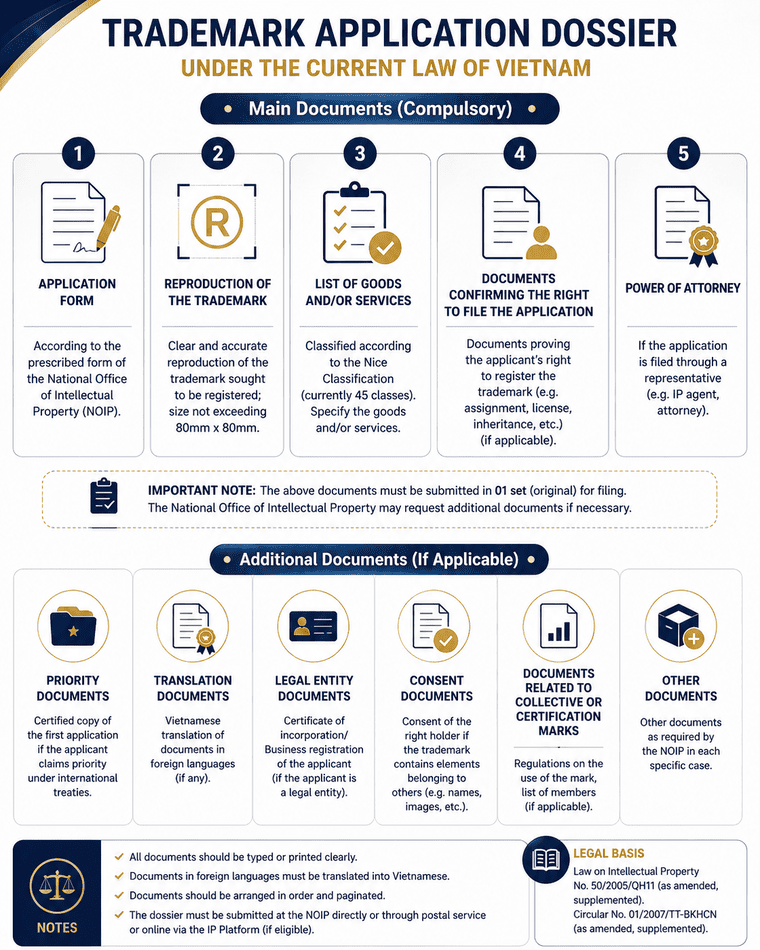
A standard trademark application dossier generally includes:
- Trademark application form;
- Trademark specimen/logo;
- List of goods and services;
- Power of Attorney (if filed through an IP representative);
- Priority documents (if applicable);
- Applicant information and supporting documents.
Foreign applicants without a commercial presence in Vietnam are generally required to file through a licensed industrial property representative organization.
Step 4: File the Application with the Intellectual Property Office of Vietnam
Trademark applications are submitted to the Intellectual Property Office of Vietnam (IP Vietnam).
Applications may currently be filed through:
- Direct submission;
- Postal filing;
- Online filing through electronic systems.
The filing date is extremely important because Vietnam applies the first-to-file principle.
Once accepted, the applicant receives an application number and official filing date.
Step 5: Formality Examination
The application will undergo formality examination to verify compliance with administrative and procedural requirements.
This stage generally reviews:
- Completeness of documents;
- Proper classification;
- Filing fees;
- Application format.
If the dossier is valid, the application will be accepted for publication.
If deficiencies exist, the applicant must amend or supplement documents within the prescribed timeline.
Step 6: Publication of Trademark Application
Accepted applications are published in the Industrial Property Gazette.
Publication allows third parties to monitor and potentially oppose trademark applications that may conflict with their rights.
Trademark opposition has become increasingly common in Vietnam, particularly in sectors such as:
- Food and beverage;
- Cosmetics;
- Technology;
- Fashion;
- Hospitality;
- Retail and franchising.
Step 7: Substantive Examination
This is the most critical stage of the trademark registration process.
The Intellectual Property Office evaluates whether the trademark satisfies substantive protection conditions, including:
- Distinctiveness;
- Non-confusing similarity;
- Non-descriptive nature;
- Compliance with public policy and prohibited signs.
Under the Intellectual Property Law 2025, examination standards continue to become stricter and more sophisticated, especially regarding trademarks containing foreign words, geographical elements, and descriptive terminology.
The substantive examination period may take several months depending on complexity and workload.
Step 8: Grant of Trademark Registration Certificate
If the application satisfies all legal conditions, the Intellectual Property Office will issue a Trademark Registration Certificate.
Trademark protection in Vietnam generally lasts for 10 years from the filing date and may be renewed indefinitely for successive 10-year periods.
Once registered, trademark owners obtain exclusive legal rights to:
- Use the trademark;
- License the trademark;
- Transfer ownership;
- Request enforcement against infringement;
- Record trademark rights with customs authorities.
Common Mistakes in Trademark Registration
In practice, many trademark applications face rejection or delays due to avoidable errors such as:
- Filing without prior search;
- Incorrect Nice classification;
- Descriptive or weak trademarks;
- Similarity with existing trademarks;
- Inconsistent applicant information;
- Inadequate goods/service descriptions.
Professional legal support therefore plays a critical role in minimizing legal and procedural risks.
La Défense – Trademark Registration Services in Vietnam
La Défense Vietnam Law Firm provides comprehensive trademark registration and intellectual property advisory services for domestic and international clients operating in Vietnam.
Our legal services include:
- Trademark search and legal assessment;
- Trademark filing strategy consultation;
- Preparation and submission of trademark applications;
- Handling office actions and oppositions;
- Trademark renewal and assignment;
- Trademark enforcement and dispute resolution;
- Cross-border IP portfolio management.
With extensive experience advising businesses, foreign investors, startups, technology companies, and international brands, La Défense delivers strategic and practical intellectual property solutions tailored to modern business operations in Vietnam.
For consultation regarding trademark registration and intellectual property protection in Vietnam, please contact:
LA DÉFENSE VIETNAM LAW FIRM
Email: office@ladefense.vn
Website: https://vietnamlawfirm.com.vn
Hotline: +84 24 8888 1118
Disclaimer: This article is for informational purposes only and does not constitute formal legal advice. Legal regulations and administrative practices may change over time depending on applicable laws and guidance from competent authorities.
Read more relavant other articles:
- Your Ultimate Blueprint for Filing a Trademark Application in Singapore in 2025
- Do You Use R or TM for Trademark?
- Can US Trademarks Exist Without Registration? A Simple Guide for 2025