

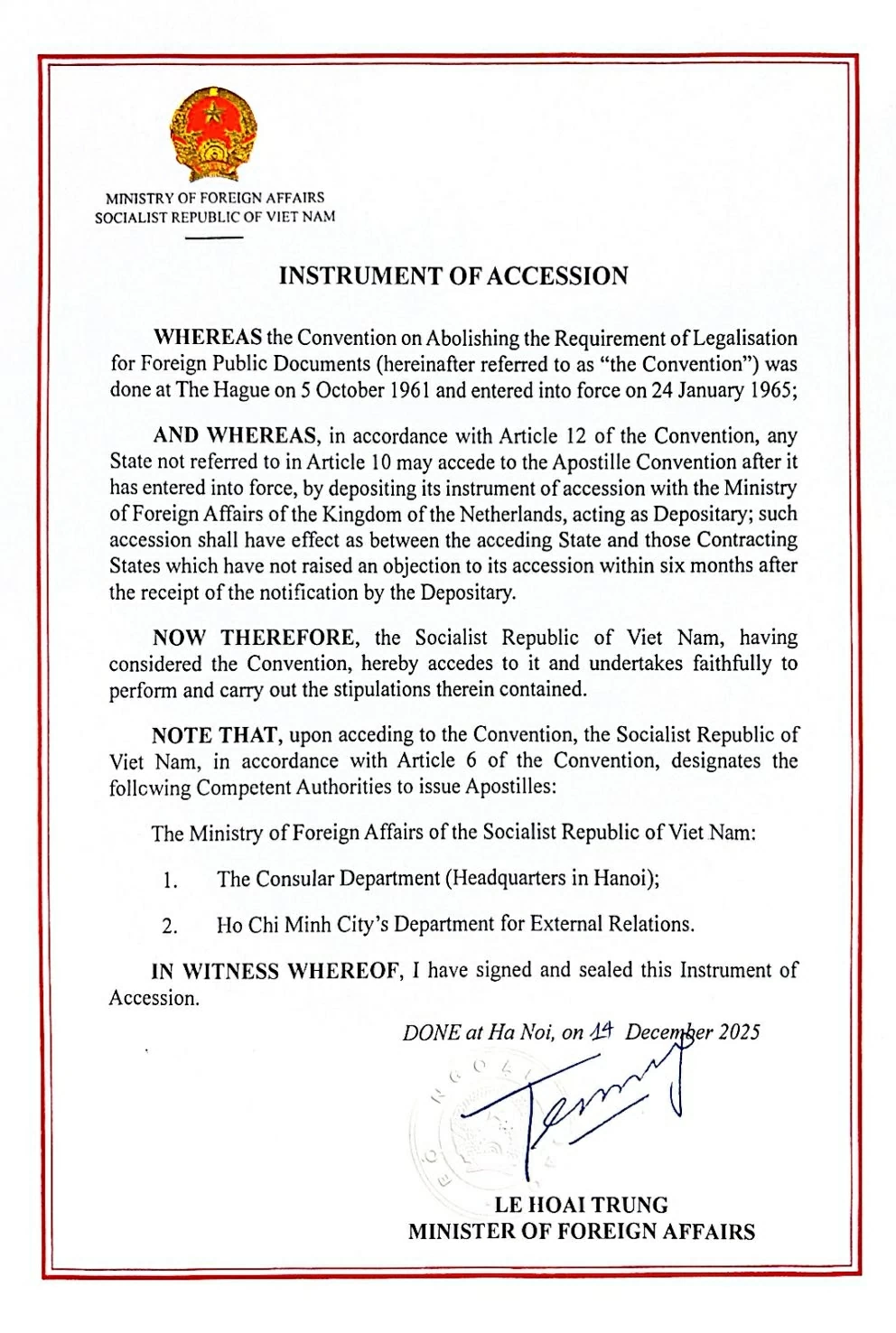
Vietnam’s official implementation of the Apostille mechanism from September 11, 2026 is not merely a technical administrative reform, but reflects a profound shift in legal thinking and international integration. In the context of increasingly frequent cross-border transactions, particularly in investment and international trade, the method of authenticating public documents plays a foundational role in ensuring the legal certainty of such transactions. The transition from the traditional consular legalization regime to the Apostille mechanism therefore not only simplifies procedures, but also contributes to reshaping how Vietnam’s legal system operates in its interaction with the global environment.

The Legal Nature of the Apostille Mechanism
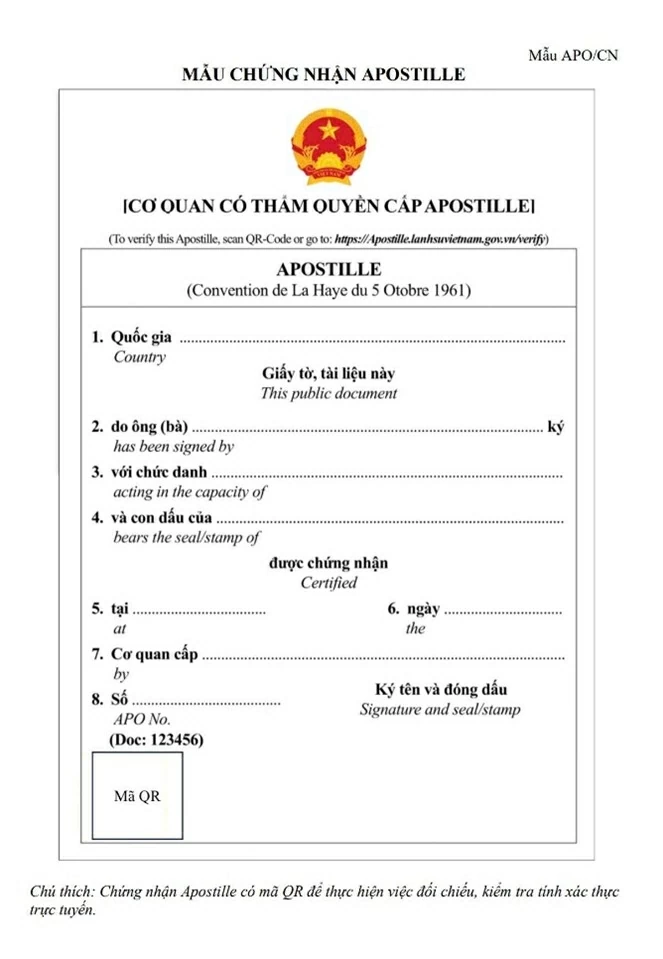
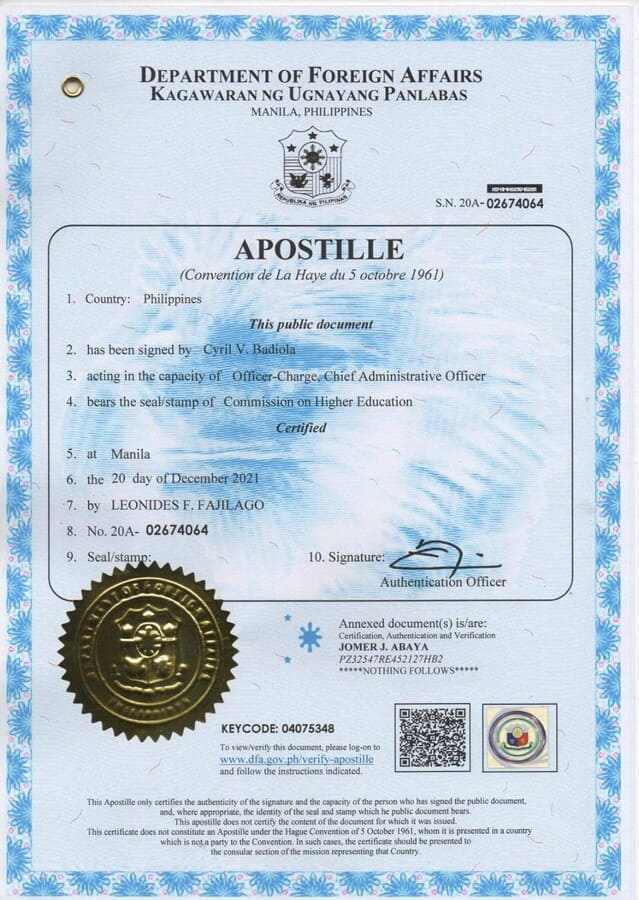
The Apostille mechanism is established under the Hague Convention of 1961 Abolishing the Requirement of Legalisation for Foreign Public Documents, with the core objective of eliminating the requirement for consular legalization among member states. From a legal perspective, an Apostille does not certify the substantive content of a document, but is limited to confirming the formal authenticity of the document, including the signature, seal, and the capacity of the signatory.
It is precisely this deliberate limitation that creates a simple yet effective authentication mechanism, as it clearly distinguishes between the “formal validity” and the “substantive value” of a document. Once a document is issued with an Apostille, member states may accept it without repeating multiple layers of verification, thereby establishing a standardized level of legal trust across jurisdictions.
From Consular Legalization to Apostille: A Shift in Regulatory Approach
For many years, the authentication of foreign documents in Vietnam has been carried out through the consular legalization mechanism under Decree No. 111/2011/ND-CP on consular certification and legalization. This process is inherently a “chain of authentication,” where each step depends on the validation of the preceding one, involving multiple authorities from the originating country to Vietnamese diplomatic missions.
While this approach reflects a strict control model, it also creates significant delays in document processing and increases compliance costs. In contrast, the Apostille mechanism embodies a different regulatory philosophy: instead of multiple layers of verification, the legal system recognizes a single standardized certification mutually accepted among member states.
This shift not only shortens procedures but, more importantly, signifies a transformation from “trust based on control” to “trust based on shared standards.”
Implications for Investment Activities and Cross-Border Transactions
The most visible impact of the Apostille mechanism arises in transactions involving foreign elements, where cross-border legal documentation is essential. In practice, procedures such as the establishment of foreign-invested enterprises, execution of M&A transactions, or implementation of investment projects typically require a substantial volume of documents issued abroad, including charters, corporate resolutions, financial capacity documents, and personal identification records of investors.
Under the previous regime, each of these documents had to undergo a lengthy legalization process, often becoming a bottleneck that delayed the entire transaction timeline. With the adoption of Apostille, such documents require only a single certification in the country of origin, thereby significantly reducing preparation time and enhancing flexibility in executing investment decisions.
More broadly, this contributes to lowering “market entry costs,” a factor that directly influences foreign investors’ decisions. As procedural time and costs are optimized, the investment environment becomes more predictable, thereby enhancing Vietnam’s attractiveness in an increasingly competitive regional landscape.
Implications for Corporate Governance and Legal Compliance
The implementation of Apostille also necessitates adjustments within corporate governance systems. For many years, internal legal procedures and international contract templates have typically assumed “consular legalization” as a mandatory requirement for foreign documents. With the legal framework changing, these assumptions must be reviewed and updated to avoid unnecessary risks.
At an operational level, in-house legal and compliance teams must clearly understand the scope of application of Apostille, as well as its limitations, to ensure that documents are prepared correctly from the outset. This is particularly critical in high-value transactions, where even minor errors in document authentication may result in rejection or delays in processing.
At the same time, Apostille contributes to reducing risks arising from inconsistencies among administrative authorities. As procedures become simplified and standardized, the predictability of administrative outcomes improves, enabling businesses to better plan and control timelines.
Scope Limitations and Practical Considerations
Despite its advantages, the Apostille mechanism is not a universal solution. First, its application is limited to member states of the Convention. For documents originating from non-member countries, the traditional consular legalization process remains applicable.
Furthermore, Apostille applies only to “public documents,” while many documents used in commercial transactions—such as private contracts or internal corporate documents that have not been notarized—may fall outside its scope. Therefore, correctly identifying the legal nature of a document is a prerequisite for determining the appropriate authentication method.
In practice, another challenge lies in verifying the validity of Apostilles, particularly given that each country may have different formats and competent authorities. This requires businesses and legal practitioners to possess sufficient knowledge to avoid the risk of relying on invalid documents.
Apostille as an Indicator of Institutional Reform
Vietnam’s adoption of the Apostille mechanism should be viewed within the broader context of institutional reform, aimed at building a transparent, efficient, and internationally aligned legal system. Beyond simplifying procedures, Apostille reinforces investor confidence in the functioning of Vietnam’s legal framework.
In the long term, the impact of this reform extends beyond reducing time and cost, contributing instead to enhancing institutional quality—an increasingly important competitive advantage in attracting investment and supporting economic development.
This article is provided for general informational and analytical purposes only and does not constitute formal legal advice. For specific cases, businesses and investors are advised to seek our professional legal counsel / lawyers to obtain tailored solutions appropriate to their particular circumstances.
Read more other relavant articles:
- FDI Enterprises and the Private Sector Question: An Emerging Interpretative Risk in Vietnam’s Tax Incentive Framework
- Foreign Ownership below 50% in Vietnamese Companies: Is M&A Approval Required and Does the Company Qualify as an FDI Enterprise?
- FDI Investment Structures in Vietnam under the 2025 Investment Law: IRC, ERC and M&A Approval in a Post-Licensing Regulatory Framework
- Tax Obligations and Incentives for FDI Companies in Vietnam