

I. When IP compliance is no longer a procedural exercise
For many years, intellectual property (IP) compliance in Vietnam was largely perceived as a procedural matter: registering trademarks, filing patent applications, or enforcing rights when infringements occurred. This approach was consistent with a legal framework primarily focused on the recognition and protection of rights.

However, with the amended Intellectual Property Law (2025), effective from 1 April 2026, together with its implementing instruments—most notably Decree No. 100/2026/ND-CP—this logic has fundamentally shifted. The law no longer merely recognises and protects IP rights; it redefines them as assets that must be managed, exploited, and integrated into business operations.
This transformation carries a critical implication: IP compliance is no longer about whether a company holds a certificate of protection. It is about whether the company has a system in place to manage and leverage its IP assets. It is precisely at this transition point that a range of legal risks emerges—many of which are not immediately visible when viewed through a purely procedural lens.
II. A new type of obligation: IP governance without formal enforcement
One of the most notable developments in the new legal framework is the introduction of an internal governance obligation concerning IP assets. Decree No. 100/2026/ND-CP expressly requires enterprises to establish and maintain an inventory of their IP rights, including information on legal status, origin, development costs, commercialisation status, and estimated value.
What makes this requirement particularly distinctive is that it is not accompanied by any formal administrative procedure. Enterprises are not required to register or submit this inventory to any authority. Nor is there an explicit sanction for non-compliance.
This may create the impression that the obligation is optional or of limited legal significance. In reality, however, it reflects a form of “soft compliance”. Rather than imposing direct administrative control, the law places responsibility on enterprises to organise their own governance systems. In this context, the IP inventory is not a regulatory formality—it is an internal legal instrument whose significance becomes evident only when a legal event occurs.
III. The most significant risk: when non-compliance does not trigger immediate consequences
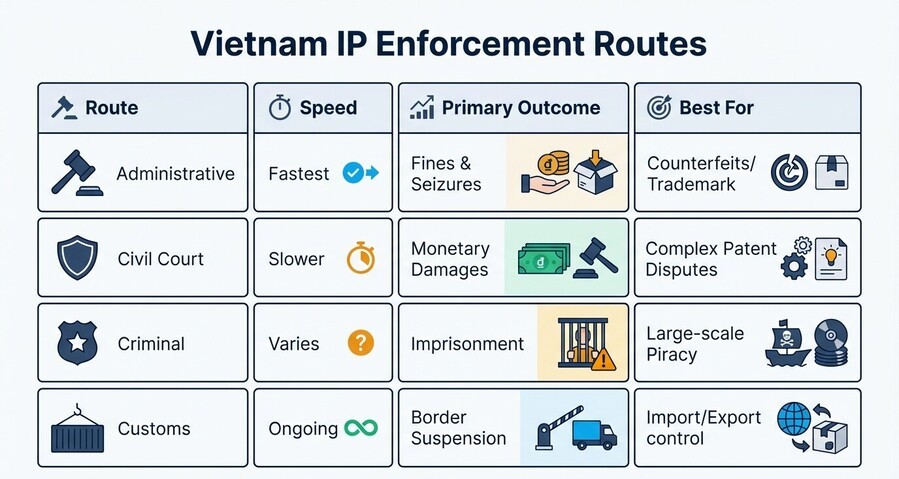
The absence of direct sanctions creates what may be described as a “false sense of security”. An enterprise may choose not to establish an IP inventory or governance system and still face no immediate legal consequences. Yet the risks do not disappear—they are merely deferred.
In practice, such risks tend to materialise in situations that businesses do not anticipate: an M&A transaction, an investment round, an audit, or an internal dispute. At that point, the relevant question is no longer whether the enterprise has registered its IP rights, but whether it can demonstrate ownership, trace the origin of those rights, and substantiate their value.
It is not uncommon for enterprises to possess valuable IP assets without having any structured documentation of their creation, assignment, or exploitation. In such cases, the asset exists in fact but not in law. This represents a distinct category of risk: one that arises not from wrongdoing, but from a lack of preparedness.
IV. Ownership in the age of digitalisation and AI: an emerging grey area
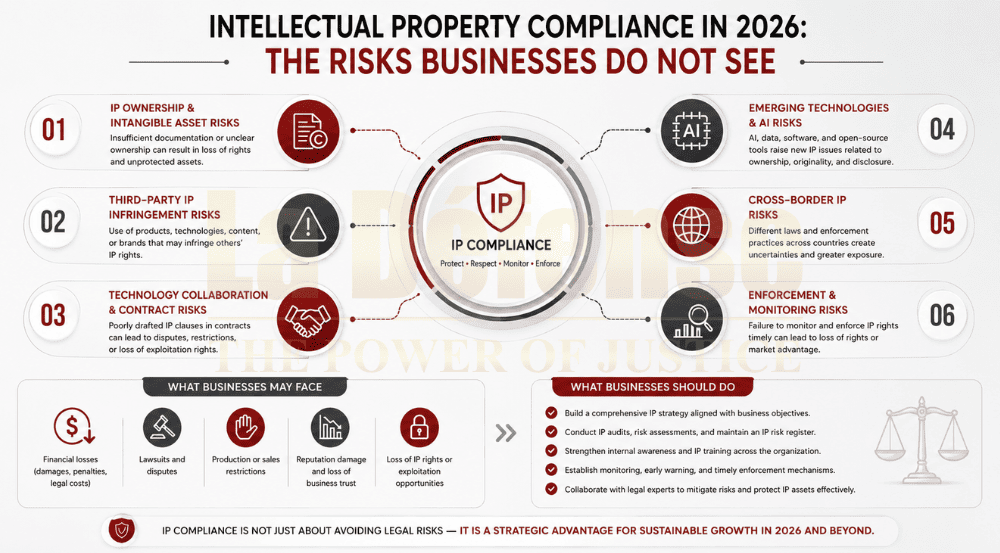
Another important feature of Decree No. 100/2026/ND-CP is its initial attempt to address IP issues in the context of artificial intelligence. The regulation maintains a human-centric approach by requiring a significant human contribution for an IP asset to qualify for protection.
In practice, however, the boundary is far from clear. Where AI is involved in the creation process, determining authorship, ownership, and the extent of human contribution becomes highly complex. Without a structured system to document and control the creation process, enterprises may face substantial legal uncertainty.
This challenge is not limited to AI. Questions of ownership frequently arise in relation to employee-created works, outsourced designs, or third-party-developed software. As the legal framework moves towards greater transparency and accountability, these issues become increasingly critical. A well-structured IP inventory, in this context, serves not only as a management tool but also as crucial legal evidence.
V. IP compliance in transactions: from ancillary issue to deal-breaker
In investment and M&A transactions, IP assets are no longer peripheral considerations—they are often central to valuation and deal viability. Investors are not merely interested in whether a company holds IP rights; they seek assurance that such rights are validly owned, properly documented, and capable of commercial exploitation.
In practice, numerous transactions are delayed or even abandoned due to deficiencies in IP documentation. The absence of a clear inventory, incomplete ownership records, or invalid licensing arrangements can significantly undermine a company’s valuation.
Against this backdrop, the requirement to establish an IP inventory under the new legal framework is not merely a compliance issue. It is directly linked to a company’s ability to attract investment and participate in high-value transactions.
VI. Compliance in the digital environment: risks from both sides
With the rapid expansion of e-commerce and digital platforms, IP infringements have become more frequent, more widespread, and more difficult to control. The new regulatory framework reflects this trend by introducing mechanisms for automated monitoring and enforcement of IP rights in the digital environment.
However, while regulators are moving towards proactive, technology-driven enforcement, many enterprises still lack internal systems to monitor the use of their IP assets online. This creates a dual risk: businesses may fail to detect infringements against their own rights, or they may inadvertently infringe the rights of others.
In both scenarios, the absence of a structured IP governance system places the enterprise in a reactive position—without data, without evidence, and without the ability to respond effectively.

VII. IP compliance as a matter of governance, not procedure
Overall, the IP legal framework in 2026 does not impose a significant number of new administrative obligations. Instead, it introduces a more demanding expectation in terms of internal governance. Enterprises are not required to submit reports, but they are expected to build and maintain their own systems if they wish to protect and exploit their IP assets effectively.
Perhaps most importantly, the most significant risks in this area do not arise from clear legal violations, but from gaps in governance—issues that remain invisible until it is too late. By that stage, the cost of remediation is often far greater than the cost of prevention.
In this evolving legal landscape, IP compliance is no longer a matter of formality. It is a strategic function. Enterprises that recognise and act on this shift at an early stage will be better positioned to navigate the increasing legal and commercial significance of intangible assets.
Read more other relavant articles:
- Home Ownership for Foreigners in Vietnam (2026 Guide)
- Appealing Trade Remedy Decisions in Vietnam: Options, Procedures and Practical Insights for Foreign Exporters
- Confidentiality Protection in Vietnam’s Trade Remedy Investigations: What Exporters Need to Know
- Trademark Registration Procedure in Vietnam Under the Intellectual Property Law 2025